
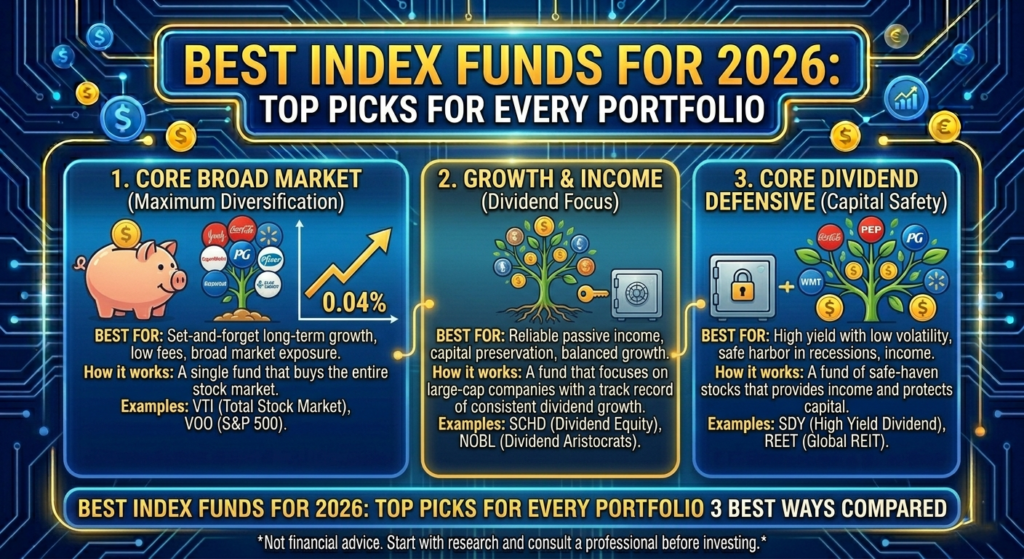
ou don’t need 30 different index funds to build a solid portfolio in 2026. You just need a handful of best‑in‑class options for each core slice: U.S. stocks, international, bonds, small‑cap, REITs, and all‑in‑one target‑dates. If you want to know which index funds actually matter, this page gives you a specific, broker‑agnostic set of picks: VTI, VOO, FZROX, VXUS, BND, VB, AVUV, VNQ, and leading Vanguard, Fidelity, and Schwab target‑date funds.
You’ll walk away knowing:
- The best low‑cost index funds for each category and why they beat the rest.
- A simple 3‑fund portfolio recipe using VTI, VXUS, and BND.
- How Fidelity’s zero‑fee share classes work and their one quirk with portability.
- How to place index funds in taxable vs tax‑advantaged accounts so you don’t over‑pay on taxes.
You can copy this structure into any brokerage (Vanguard, Fidelity, Schwab, Robinhood, SoFi, etc.) and still own the same core index‑fund blueprint.
What “best index funds” actually means in 2026
When most people say index funds, they mean mutual funds or ETFs that track a broad market or factor index and charge a low fee for the job. In 2026, the main players are Vanguard, Fidelity, Schwab, and iShares, with a few solid specialty funds scattered throughout.
Key things to watch:
- Expense ratio: Lower is almost always better for broad‑market funds (aim under 0.10% where you can).
- Tracking error: How closely the fund matches its index (small is good).
- Assets under management (AUM): Larger funds are usually cheaper and more liquid.
If you want to dig into a fund, pull the prospectus from the issuer’s website, scroll to the expense ratio section, and check that it’s under 0.20% for any broad‑market index fund.
Total U.S. stock market: VTI vs FZROX
This is your core U.S. stock bucket. It holds thousands of American companies in one shot.
Vanguard Total Stock Market ETF (VTI)
- Expense ratio: 0.03% (as of 2026 data).
- Benchmark: CRSP US Total Market Index.
- Holdings: Roughly 4,000+ U.S. stocks, from mega‑caps to small‑caps.
- Why it’s strong: Ultra‑low fee, broad diversification, and negligible tracking error.
VTI is one of the go‑to total‑market index funds for 2026. You can hold it in taxable accounts, Roth IRAs, or traditional IRAs with benefit.
Fidelity ZERO Total Market Index Fund (FZROX)
- Expense ratio: 0.00% (no‑fee share class).
- Benchmark: Fidelity U.S. Total Market Index.
- Holdings: Similar in spirit to VTI—thousands of U.S. companies.
FZROX is technically “free” to own as long as you hold it at Fidelity. The core drawback:
- If you Transfer‑out of Fidelity, the ZERO‑fee share class usually can’t move.
- You either sell it and accept market risk at transfer time or convert to a regular version (FZILX, FXAIX, etc.) with a small fee.
For long‑term buy‑and‑hold inside Fidelity, FZROX is a winner. For portability between brokers, VTI often wins.
S&P 500 index funds: VOO, FXAIX, SWPPX
If you want a narrower, blue‑chip U.S. core, the S&P 500 is still the classic starting point.
Vanguard S&P 500 ETF (VOO)
- Expense ratio: 0.03%.
- Benchmark: S&P 500 Index.
- Holdings: Roughly 500 large‑cap U.S. companies.
- Why it’s strong: Transparent benchmark, rock‑bottom fee, massive daily liquidity.
VOO is the default S&P 500 index ETF for most nvest1now.com who want simplicity.
Fidelity 500 Index Fund (FXAIX)
- Expense ratio: 0.015%, often rounded to “near‑zero” in practice.
- Benchmark: S&P 500 Index.
- Availability: Fidelity accounts, including Roth IRAs and 401(k) rollovers.
FXAIX beats VOO on expense ratio but is tied to Fidelity’s platform.
Schwab S&P 500 Index Fund (SWPPX)
- Expense ratio: 0.02%.
- Benchmark: S&P 500 Index.
- Availability: Schwab platforms.
SWPPX is another low‑fee S&P 500 index mutual fund option if you prefer Schwab’s ecosystem.
If you can only pick one, VTI is more diversified than VOO/FXAIX/SWPPX, but VOO or FXAIX give you a “pure S&P 500” slice if you want it.
Total international stock: VXUS and FZILX
Once you have a U.S. core, you add non‑U.S. stocks for geographic diversification.
Vanguard Total International Stock ETF (VXUS)
- Expense ratio: 0.07%.
- Benchmark: FTSE Global All Cap ex‑US Index.
- Holdings: Over 7,000 stocks outside the U.S., including developed and emerging markets.
VXUS is one of the broadest international index funds available. It smooths out country‑specific risk across Europe, Asia, and emerging markets.
Fidelity ZERO International Index Fund (FZILX)
- Expense ratio: 0.00%.
- Benchmark: similar to VXUS in spirit but Fidelity’s own index.
- Usage: Only inside Fidelity accounts.
FZILX is cost‑free to hold at Fidelity and mirrors the VXUS strategy for international exposure. If you move away from Fidelity, you’ll face share‑class portability limits, just like FZROX.
Total bond index funds: BND vs FXNAX
Bonds reduce volatility and sequence‑of‑returns risk in a portfolio. For most investors, a total bond market index fund is the simplest start.
Vanguard Total Bond Market ETF (BND)
- Expense ratio: 0.03%.
- Benchmark: Bloomberg U.S. Aggregate Float‑Adjusted Index.
- Holdings: Thousands of U.S. investment‑grade bonds—government, corporate, mortgage‑backed.
BND is the standard low‑cost total bond ETF for 2026. It behaves like a core bond bucket in any 3‑fund portfolio.
Fidelity ZERO Total Bond Index Fund (FXNAX)
- Expense ratio: 0.00%.
- Benchmark: similar to BND (Fidelity U.S. Broad Investment‑Grade index).
- Availability: Fidelity accounts.
FXNAX is free to hold inside Fidelity and mirrors the BND strategy. Again, the ZERO share class won’t move cleanly if you transfer your account later.
Small‑cap and factor tilt: VB vs AVUV
If you want to tilt beyond plain market‑cap weighted, small‑cap and value‑tilt funds are common add‑ons.
Vanguard Small‑Cap ETF (VB)
- Expense ratio: 0.05%.
- Benchmark: CRSP US Small Cap Index.
- Holdings: Roughly 1,500–2,000 small‑cap U.S. companies.
VB adds small‑cap exposure without a strong factor tilt; it’s still market‑cap weighted.
Vanguard Value ETF (VTV)
- Expense ratio: 0.04%.
- Benchmark: CRSP US Large Cap Value Index.
- Holdings: Large‑cap value stocks.
For a value tilt, you can swap VTV in for a slice of VTI in a more aggressive scheme.
Vanguard Extended Market ETF (VXF) / Avantis USA Small Cap Value ETF (AVUV)
- AVUV (Avantis brand, now integrated with Charles Schwab products):
- Expense ratio roughly 0.25%.
- Focuses on U.S. small‑cap value with a rules‑based, value‑factor tilt.
- VXF (Vanguard Extended Market ETF):
- Expense ratio about 0.07%.
- Holds U.S. mid‑ and small‑cap stocks outside the S&P 500.
AVUV is the higher‑cost, factor‑tilted small‑cap play for people who believe in value‑style investing. VB is the leaner, cheaper small‑cap option.
REIT index fund: VNQ
Real estate investment trusts (REITs) add real‑estate‑like income without owning buildings.
Vanguard Real Estate ETF (VNQ)
- Expense ratio: 0.13%.
- Benchmark: MSCI US Investable Market Real Estate 25/50 Index.
- Holdings: Over 150 U.S. REITs across property types.
- Yield (2026): Roughly 3.9–4.1% distribution yield, paid quarterly.
VNQ is the go‑to broad REIT index fund for 2026. It’s not a “bond substitute,” but it adds real‑estate exposure and dividend‑like distributions.
Target‑date index funds: Vanguard, Fidelity, Schwab
If you want a fully‑automated mix of stocks and bonds, target‑date funds are index‑based “all‑in‑one” wrappers.
Vanguard Target Retirement Funds (e.g., 2030, 2040, 2050)
- Examples: Vanguard Target Retirement 2040 Fund (VSMGX), 2050, etc.
- Use underlying Vanguard index funds (U.S. total stock, total international, total bond).
- Glide path steps down stocks and steps up bonds as the target date nears.
Vanguard target‑dates are low‑cost, plain‑vanilla index‑fund wrappers with a clear glide path.
Fidelity Freedom / Freedom II Index Funds
- Examples: Fidelity Freedom Index 2040, 2050, etc.
- Expense ratios typically 0.18–0.22%, with underlying Fidelity index funds.
- Similar concept: automatic rebalancing as you approach retirement.
Schwab Target Index Funds (e.g., Schwab Target 2040 Index Fund – SWYGX)
- Expense ratio around 0.08–0.11%.
- Built from Schwab’s low‑cost index funds.
Target‑date funds are great for people who don’t want to manually rebalance or think about allocations. You pick a date (e.g., 2040) and let the fund handle the glide path.
Best index funds comparison table (2026 snapshot)
| Fund type | Example ticker / name | Expense ratio | AUM (rough 2026 style) | Notes |
| Total U.S. market | VTI – Vanguard Total Stock Market ETF | 0.03% | ~$1 Trillion+ | Ultra‑low‑cost, broad, portable anywhere. |
| S&P 500 | VOO – Vanguard S&P 500 ETF | 0.03% | ~$800 billion | Pure S&P 500 exposure, highly liquid. |
| S&P 500 (Fidelity) | FXAIX – Fidelity 500 Index | 0.015% | ~$700 billion | Slightly cheaper; Fidelity‑only. |
| Total international | VXUS | 0.07% | ~$80 billion | Broad ex‑U.S. exposure. |
| International zero‑fee | FZILX – Fidelity ZERO Intl. | 0.00% | ~$40 billion | Fidelity‑only; no‑fee but not portable. |
| Total bond | BND | 0.03% | ~$70 billion | Core U.S. bond ETF. |
| Bond zero‑fee | FXNAX – Fidelity ZERO Total Bond | 0.00% | ~$20 billion | Fidelity‑only bond option. |
| Small‑cap | VB – Vanguard Small‑Cap ETF | 0.05% | ~$30 billion | Pure U.S. small‑cap index. |
| Small‑cap factor tilt | AVUV – Avantis Us Small Cap Value | ~0.25% | Several billion | Value‑tilted small‑cap. |
| REIT | VNQ – Vanguard Real Estate ETF | 0.13% | ~$40 billion | Broad U.S. REIT index. |
This table gives you a quick reference for 2026’s best index funds without rewriting your whole allocation strategy.
How to build a 3‑fund index‑fund portfolio
One of the most reliable index‑fund recipes is the classic 3‑fund portfolio:
- Total U.S. stock market (VTI).
- Total international stock market (VXUS).
- Total bond market (BND).
Simple example mix:
- 60% VTI (U.S. stocks).
- 20% VXUS (international stocks).
- 20% BND (U.S. bonds).
You can adjust the equity‑to‑bond ratio based on your age and risk tolerance:
- Younger investors: 80–90% stocks.
- Near‑retirement: 50–60% stocks.
If you use Fidelity ZERO funds inside Fidelity, you can swap:
- FZROX for VTI.
- FZILX for VXUS.
- FXNAX for BND.
Just remember the portability quirk; you can’t usually drag ZERO share classes wherever you want.
Fidelity ZERO funds and the portability quirk
Fidelity’s ZERO series (FZROX, FZILX, FXNAX, etc.) are powerful because they cost 0.00% to hold, but there is a catch:
- The ZERO share class is designed for in‑house use only.
- If you move your account out of Fidelity, the ZERO shares cannot be transferred intact.
- You either sell them and buy the regular class elsewhere (e.g., FXAIX for S&P 500) or convert to a non‑ZERO version at Fidelity and then move.
Practical tip:
- If you’re sure you’ll stay at Fidelity long‑term, ZERO funds are fantastic.
- If you’re uncertain, consider portable ETFs like VTI, VXUS, and BND instead.
This quirk does not make ZERO funds bad; it just makes them platform‑specific.
Taxable vs tax‑advantaged placement of index funds
How you place index funds in taxable accounts vs retirement accounts can materially change your after‑tax returns, even with low‑cost ETFs.
General rules for 2026
- Hold bonds and REITs inside tax‑advantaged accounts (Roth IRA, traditional IRA, 401(k)) whenever possible.
- Why: They throw off ordinary‑income‑like distributions; shielding them from annual tax drag matters.
- Hold broad‑market U.S. stock ETFs (VTI, VOO, VB, VNQ) in taxable accounts.
- Reason: They generate mostly qualified dividends and long‑term capital gains, which are taxed at lower rates.
- Hold tax‑efficient international ETFs (VXUS) in taxable accounts if you need them, but know:
- Foreign dividends may be non‑qualified and taxed at your ordinary rate.
- Tax‑credits or withholding is usually handled by the fund.
If you want more granular guidance, look at the tax status of your dividends (qualified vs ordinary) inside your brokerage’s tax‑lot screen and favor tax‑advantaged space for bond‑heavy and REIT funds.
Next step for your index‑fund journey
If you already own a single target‑date fund, you don’t need a 3‑fund portfolio; you can keep it simple. If you want more control and lower fees, move to VTI, VXUS, and BND (or their Fidelity/Schwab equivalents).
If you want to see how different index‑fund mixes grow over 10–30 years at different withdrawal rates,

