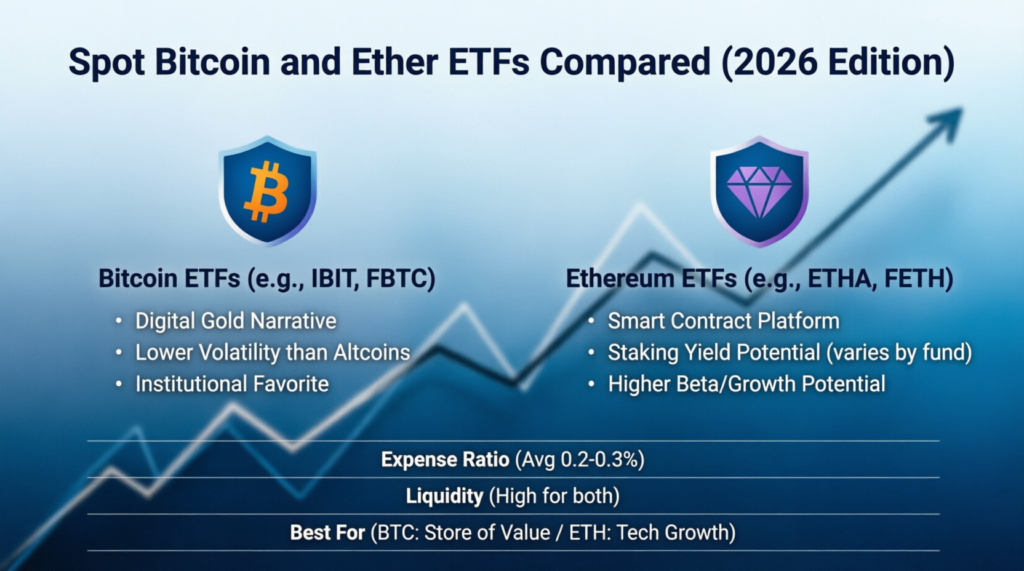
If you want to pick the best Bitcoin ETF in 2026, you’re not choosing between “good” and “bad.” You’re choosing between who holds the coin, how much the fund costs you, and whether you want exposure to Bitcoin, Ether, or both. Spot Bitcoin ETFs (IBIT, FBTC, ARKB, BITB, HODL) and Ether ETFs (ETHA, FETH, ETHE) now live in the same menus as SPY, VOO, and VNQ, and each one has a real expense ratio, AUM, and liquidity story behind it.
You’ll walk away knowing:
- A side‑by‑side comparison of IBIT, FBTC, ARKB, BITB, HODL, ETHA, FETH, ETHE with AUM, fees, and liquidity.
- Why these ETFs matter in 2026 (IRA eligibility, no self‑custody risk, simpler taxes).
- The drawbacks vs holding actual coin (no on‑chain use, limited or no staking yield on most ETH ETFs).
- How to position‑size them in a portfolio that already includes VTI, VOO, VXUS, BND, and VNQ.
This is a real‑numbers, 2026‑style guide for someone who already knows how to buy an ETF and wants to know which crypto‑ETF tickers make sense.
Why spot Bitcoin and Ether ETFs matter now
Spot Bitcoin ETFs and Ether ETFs are regulated funds on the stock market that hold real Bitcoin or Ether behind the scenes. You trade them like VOO at 0.03%, except you’re paying 0.20–0.25% instead of a fraction of that.
What they give you:
- IRA eligibility: Many self‑directed IRAs and brokerage‑IRA accounts now let you buy IBIT, FBTC, ETHA, FETH, and similar tickers without touching crypto exchanges.
- No self‑custody risk: You don’t need a Ledger, Trezor, or seed‑phrase vault; the custodian handles storage.
- Simpler tax reporting: You get 1099‑DIV / 1099‑B, not a blockchain‑tax‑export spreadsheet.
What you give up:
- No direct on‑chain access (no DeFi, no lending, no running a node).
- Limited staking yield on most Ether ETFs (except a few like ETHE).
If you want crypto exposure in a taxable brokerage or IRA but don’t want to wrestle with wallets, these ETFs fit.
Bitcoin ETFs compared: IBIT, FBTC, ARKB, BITB, HODL
Here are the main spot Bitcoin ETFs you’ll see in 2026, with real numbers and trade‑offs.
1. IBIT (BlackRock)
IBIT Bitcoin ETF Calculator
- Ticker: IBIT
- Issuer: BlackRock / iShares
- Expense ratio: 0.25%; BlackRock started with a fee‑waiver phase, but that is narrowing or expiring in 2026.
- Assets under management (AUM): Roughly $60B+, making IBIT the largest spot Bitcoin ETF by AUM.
- Average daily volume: Very high; $1B+ daily in many months.
- Premium/discount to NAV:
- IBIT often trades near NAV, with occasional small premiums or discounts (±0.5–1%) depending on flow and market sentiment.
IBIT is the default “buy‑button” for most institutions and retail investors who want maximum liquidity and size.
2. FBTC (Fidelity)
- Ticker: FBTC
- Issuer: Fidelity
- Expense ratio: 0.25% base, with a now‑winding fee‑waiver program.
- AUM: Several tens of billions, second only to IBIT in size.
- Custody: Fidelity handles in‑house custody and vaulting, similar to their SPY‑style ETF infrastructure.
- Volume and pricing:
- High average daily volume, typically $100M–$500M+.
- Pricing is usually within 0.3–0.8% of NAV.
FBTC is a strong alternative to IBIT if you already bank with Fidelity or prefer their custody model.
3. ARKB (ARK 21Shares Bitcoin ETF)
- Ticker: ARKB
- Issuer: ARK Invest + 21Shares
- Expense ratio: 0.21% management fee, undercutting IBIT and FBTC slightly.
- AUM: Around $2.9B as of April 2026.
- Average daily volume: Lower than IBIT/FBTC, often in the $20M–$100M range.
- NAV pricing: ARKB tends to trade very close to NAV, with occasional small premiums.
ARKB is a lower‑fee, smaller‑size Bitcoin ETF that suits investors who want ARK’s brand and cheaper management.
4. BITB (Bitwise Bitcoin ETF)
- Ticker: BITB
- Issuer: Bitwise
- Expense ratio: 0.20%, which is among the lowest base fees in the spot‑Bitcoin ETF space.
- AUM: Roughly $300M–$600M depending on flows.
- Volume and NAV:
- Moderate daily volume; slightly less liquid than IBIT/FBTC.
- Usually trades near NAV, with occasional 0.5–1% spreads when flows are thin.
BITB is a niche, low‑cost Bitcoin ETF suitable if you want Bitwise’s research and lower fees, but you must accept skinnier markets.
5. HODL (VanEck Bitcoin ETF)
- Ticker: HODL
- Issuer: VanEck
- Expense structure: VanEck runs HODL with a fee waiver, effectively 0% fund‑level management fee on the first $2.5B in AUM.
- AUM: Around mid‑single‑digit billions as of 2026.
- Volume and NAV:
- Daily volume often $10M–$50M.
- Pricing is usually near NAV, with occasional tight spreads.
HODL is the only major spot‑Bitcoin ETF with a full‑fee‑waiver in 2026, which can be a big edge for long‑term holders.
Ether ETFs compared: ETHA, FETH, ETHE
If you want Ethereum exposure in a 2026‑style ETF wrapper, you mainly choose between ETHA, FETH, and ETHE.
1. ETHA (BlackRock iShares Ethereum Trust)
- Ticker: ETHA
- Issuer: BlackRock / iShares
- Expense ratio: 0.25% base, with a reduced 0.12% fee on the first $2.5B AUM during a limited‑time waiver.
- AUM: Around $7–8B as of April 2026.
- Volume and NAV:
- ETHA trades against a relatively smaller AUM base, so you can see larger spreads (0.5–1.5%) than big‑AUM Bitcoin ETFs.
ETHA is the default large‑cap Ether ETF for most investors comfortable with BlackRock’s structure.
2. FETH (Fidelity Advantage Ether ETF)
- Ticker: FETH
- Issuer: Fidelity
- Expense ratio: 0.25% (standard spot‑Ether ETF fee).
- AUM: Roughly $70M+ as of 2026, meaning it’s much smaller than ETHA.
- Structure:
- For each share, FETH holds a small slice of actual Ether stored in Fidelity’s vaults.
- The fund discloses how many ether it holds and its NAV daily.
FETH is less liquid but fits if you already use Fidelity and want to bundle Bitcoin and Ether ETFs under one custodian.
3. ETHE (Grayscale Ethereum Staking ETF)
- Ticker: ETHE
- Issuer: Grayscale
- Expense ratio: Typically 0.25%+, but it also passes back staking rewards to shareholders.
- Staking angle:
- As of 2026, ETHE is one of the few Ether ETFs that actually stakes its Ether and distributes staking‑reward proceeds to shareholders.
- AUM and volume:
- Decent but smaller than ETHA, with moderate liquidity.
If you want Ether plus a staking‑like yield in an ETF wrapper, ETHE stands apart from plain spot‑Ether ETFs like ETHA and FETH.
Side‑by‑side ETF comparison table (2026)
| ETF | Asset | Issuer | Expense Ratio* | AUM (2026) | Typical Daily Volume | NAV Pricing Behavior |
| IBIT | Spot Bitcoin | BlackRock / iShares | 0.25% | ~$63.7B | $1B+ | Often ±0–1% NAV |
| FBTC | Spot Bitcoin | Fidelity | 0.25% | Several $10B+ | $100M–$500M+ | Usually ±0.3–0.8% NAV |
| ARKB | Spot Bitcoin | ARK 21Shares | 0.21% | ~$2.9B | $20M–$100M | Near NAV, occasional small premium |
| BITB | Spot Bitcoin | Bitwise | 0.20% | ~$300M–$600M | $10M–$30M | Often ±0.5–1% NAV |
| HODL | Spot Bitcoin | VanEck | Effectively 0% on first $2.5B | Mid‑single‑digit B | $10M–$50M | Near NAV, tight spreads |
| ETHA | Spot Ether | BlackRock / iShares | 0.25% (waiver to 0.12% on first $2.5B) | ~$7–8B | $100M–$300M+ | ±0.5–1.5% NAV, varies |
| FETH | Spot Ether | Fidelity | 0.25% | ~$70M+ | $1M–$10M | Small but thin markets |
| ETHE | Staking Ether ETF | Grayscale | ~0.25%+ plus staking‑reward distributions | Medium AUM | Low–moderate | Can gap more on strong flows |
*Fee‑waiver status changes over time; always check the issuer’s prospectus.
Use this table as your ETF‑menu cheat sheet when you open your Fidelity, Charles Schwab, Robinhood, or Interactive Brokers screen.
IRA eligibility, taxes, and custody advantages
One of the biggest reasons 2026‑style investors pick these ETFs is retirement‑account access.
- IRA‑friendly crypto exposure:
- You can buy IBIT, FBTC, ETHA, FETH, ETHE, ARKB, BITB, HODL in Roth IRA, Traditional IRA, and some 401(k)s that allow crypto ETFs.
- No wallet risk:
- You don’t store seed phrases or cold‑wallet backups; the custodian handles vault‑level custody.
- Simpler taxes:
- You report capital gains when you sell shares, just like VOO or VOO.
- No need to track every on‑exchange trade, airdrop, or DeFi swap for tax purposes.
If you ever hesitated to buy direct Bitcoin because of wallet‑ops, seed‑phrase stress, or messy tax tracking, these ETFs remove those headaches at the cost of small annual fees.
Drawbacks vs holding actual Bitcoin or Ether
ETFs are convenient, but they are not the same as owning BTC or ETH in your own wallet.
- No on‑chain use:
- You can’t send BTC from IBIT to a DeFi protocol or use ETH from ETHA to stake on Lido or to participate in governance.
- Limited staking:
- Most Ether ETFs (ETHA, FETH) are non‑staking; you only get price appreciation and fund‑level fees, not staking yield.
- ETHE is a rare exception that does stake and pass back rewards, but you still don’t control the validator stack.
- Fees pile up over time:
- A 0.20–0.25% fee on $10,000 is $20–$25 per year.
- Over 20 years, that can nibble several percentage points of compounded return.
If you want full on‑chain flexibility or staking‑like yield, you must hold actual coin via an exchange and a self‑custody wallet.
How to position‑size spot Bitcoin and Ether ETFs
Crypto ETFs should be satellite holdings, not your core. Here’s how to think about sizing them alongside VOO, VTI, VXUS, BND, VNQ, SCHD, SPY, QQQ, VOO, XBI, ARKG, etc.
- Risk‑adjustment guideline:
- Many quant papers and portfolio‑management shops suggest 0–5% Bitcoin and 0–3% Ether of total portfolio as a reasonable risk budget for most investors.
- Practical ranges:
- Conservative: 0–1% Bitcoin + 0–0.5% Ether.
- Moderate: 1–3% Bitcoin + 0.5–1.5% Ether.
- Aggressive: 3–8% Bitcoin + 1–3% Ether (you must accept 50–70% drawdowns in single years).
Example:
- If your investable assets are $100,000:
- Moderate allocation:
- $1,000–$3,000 in a Bitcoin ETF (IBIT, FBTC, or ARKB).
- $500–$1,500 in an Ether ETF (ETHA or ETHE).
- Moderate allocation:
If you want to see how a $1,000 allocation to IBIT at 0.25% vs a $1,000 direct‑BTC position grows over 5–30 years with different volatility and fee assumptions, you can model both in an nvest1now.com Growth Calculator tailored to crypto‑ETFs and spot‑crypto.