If you trade, stake, or spend Crypto taxes in 2026, you are not untaxable until the IRS sends a letter. You are taxable when you sell, swap, spend, mine, stake, or airdrop, and the IRS wants you to report those events on Form 8949 and Schedule D just like you would for stocks.
You’ll walk away knowing:
- Exactly which crypto actions are tax events (and which are not, like buying with USD or moving between wallets).
- How short‑term vs long‑term gains are taxed by your income bracket in 2026 (0%, 15%, 20% long‑term; up to 37% short‑term).
- How cost‑basis methods (FIFO, LIFO, HIFO, Specific ID) work under the new IRS “wallet‑by‑wallet” rule effective 2025.
- How to use crypto tax software (Koinly, CoinTracker, TokenTax, ZenLedger) to dump transaction history and spit out IRS‑ready forms.
- Why wash‑sale rules still do not apply to crypto (for now), and how to tax‑loss harvest accordingly.
- When to call a CPA who specializes in crypto instead of doing it yourself.
This is a no‑fluff, 2026‑specific crypto tax guide for US‑based investors.
Which crypto actions are taxable events
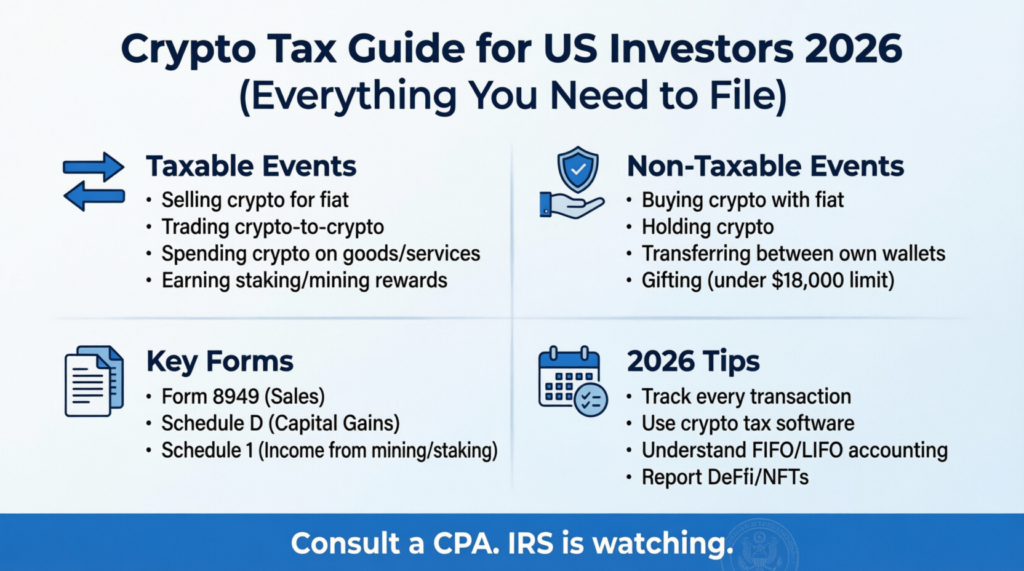
Taxable events (you owe tax)
You trigger a capital gain or loss when you:
- Sell crypto for USD or fiat (e.g., sell BTC on Coinbase for dollars).
- Swap one coin for another (e.g., BTC → ETH, SOL → BTC). This is two events in one: sell BTC, buy ETH.
- Spend crypto on goods or services (e.g., pay for a laptop, restaurant, or subscription with BTC or ETH). The IRS sees this as a disposal.
- Earn staking or validator rewards (e.g., yields from ETH, SOL, ADA). This is ordinary income at fair market value when you receive it.
- Mine crypto and receive coins as income (e.g., mining BTC, dropping those coins into your wallet). Mining rewards are ordinary income at FMV when earned.
- Sell or trade NFTs for crypto or fiat (e.g., mint an NFT, then sell it for ETH or USD). NFT sales are capital gains events.
All of these must be tracked: asset, date bought, amount paid, date sold, sale price, and resulting gain or loss.
Non‑taxable events (no tax triggered)
You generally do not create a taxable event when you:
- Buy crypto with USD (e.g., deposit dollars into Coinbase then buy BTC).
- Transfer crypto between your own wallets or exchanges (e.g., move BTC from Coinbase to a Ledger‑connected wallet, or from Kraken to Binance).
- Gift crypto under the 2026 annual gift exclusion ($18,000 per recipient).
These are bookkeeping moves, not gains/losses, though the recipient inherits your cost basis unless you intentionally gift with basis equalization.
Short‑term vs long‑term capital gains in 2026
Holding periods decide whether crypto gains are taxed like your salary or like your stocks.
- Short‑term gains:
- Held one year or less.
- Taxed at your ordinary income tax rate (up to 37%, depending on your bracket).
- Long‑term gains:
- Held more than one year.
- Taxed at reduced long‑term capital gains rates:
- 0% if you’re in the lowest brackets.
- 15% for middle‑income taxpayers.
- 20% for high‑income taxpayers.
- Some high‑earners may owe an extra 3.8% Net Investment Income Tax on top.
Practical example
- You buy 1 BTC for $33,660 (including fees).
- You sell 1 BTC for $60,000.
- Your gain is $26,340.
- If held less than 1 year → taxed at your income tax bracket (e.g., 22%, 32%, 35%).
- If held over 1 year → taxed at 0%, 15%, or 20% depending on your income.
If you trade often, most of your crypto will be short‑term and taxed more heavily.
Cost‑basis tracking and the new IRS “wallet‑by‑wallet” rule
Cost‑basis is what you originally paid for the asset (coin + fees). You must calculate gain = sale price − cost‑basis on every disposal.
Cost‑basis methods
- FIFO (First‑in, First‑out)
- You sell the oldest coins first in your entire position.
- LIFO (Last‑in, First‑out)
- You sell the most recent coins first.
- HIFO (Highest‑in, First‑out)
- You sell the highest‑cost‑basis coins first to minimize tax.
- Specific Identification
- You choose exactly which coins you sell for each trade (e.g., “sell the 1 BTC I bought at $20,000, not the one at $60,000”).
Until 2025, many investors could apply methods like FIFO or Specific ID across all wallets and exchanges.
The 2025 “wallet‑by‑wallet” change
Starting in 2025 (filed in 2026), the IRS is shifting to per‑wallet cost‑basis tracking.
- What it means:
- You no longer pool all BTC from every exchange and wallet.
- Each wallet or exchange account is treated separately.
- If you buy BTC on Coinbase at $20,000 and BTC on Kraken at $40,000, then sell BTC from Kraken, your cost‑basis must be $40,000, not $20,000.
- Practical effect:
- You lose some flexibility to cherry‑pick lowest‑cost coins across platforms.
- You must keep clean records wallet‑by‑wallet to avoid over‑ or under‑stating gains.
If you don’t track this carefully, you will under‑report gains or miss deductions.
How to file: Form 8949 and Schedule D
Crypto dispositions are reported on Form 8949 and Schedule D, the same as stocks.
Form 8949: the transaction sheet
- Every sale, swap, spend, NFT sale, or other disposal gets a line.
- Each line must show:
- Description (e.g., “0.5 BTC” or “2.0 ETH”).
- Date acquired.
- Date sold/disposed.
- Proceeds in USD.
- Cost basis in USD.
- Resulting gain or loss.
You can sort lines into short‑term vs long‑term so they flow cleanly to Schedule D.
Schedule D: the summary
- Schedule D aggregates:
- Total short‑term gain/loss (crypto + stocks).
- Total long‑term gain/loss (crypto + stocks).
- The IRS then applies your marginal rates to those totals.
If you neglect 8949 and skip entering crypto, your 1099‑DA from Coinbase or Kraken may differ from your return, triggering a CP2000 notice.
Crypto tax software: Koinly, CoinTracker, TokenTax, ZenLedger
If you made more than a handful of trades, you should use crypto tax software instead of Excel.
These tools:
- Connect to exchanges, wallets, and block explorers.
- Pull in thousands of transactions and compute cost basis, gains, and losses.
- Export Form 8949 CSV templates and Schedule D‑ready reports.
How they compare (2026 snapshot)
| Software | Key strengths | Typical pricing* |
| Koinly | Very large exchange list, supports DeFi, easy CSV export | Free tier; paid plans from ~$59/year up to $299+/year |
| CoinTracker | Strong UI, good for beginners, integrates with major exchanges | Free tier; paid plans from ~$79/year up to $299+/year |
| TokenTax | Designed for active traders and DeFi users, multi‑exchange sync | Monthly plans; higher‑tier options for big traders |
| ZenLedger | Focus on Complete, K‑1, DeFi, and NFT reporting; CPA‑ready outputs | Mid‑ to high‑priced plans for prolific traders |
*Pricing changes; check issuers for exact 2026 numbers.
If you trade on Coinbase, Kraken, Binance.US, FTX.us, or self‑custody wallets, one of these tools can cut your 8949 setup from days to hours.
Tax‑loss harvesting: crypto still has no wash‑sale rule
One of the biggest structural quirks of crypto in 2026 is that the wash‑sale rule does not apply to digital assets yet.
- Wash‑sale rule (stocks):
- Under IRS code, you cannot claim a loss if you sell a stock at a loss and buy it back (or a “substantially identical” security) within 30 days.
- Crypto in 2026:
- Crypto is treated as property, not a security, so IRC Section 1091 wash‑sale rules do not formally apply.
- You can sell BTC at a loss and buy it back immediately and still claim that loss.
How to use this (and the caveats)
- Strategic selling:
- You can sell losing positions, capture the loss, and reinvest without the 30‑day waiting period.
- But:
- Congress has discussed extending wash‑sale rules to crypto; this could change in future years.
- The IRS still expects truthful, well‑documented records. If you string together 100 identical same‑day sale/buy pairs with no economic purpose, you could attract scrutiny.
If you design clear tax‑loss‑harvesting rules (e.g., “sell if down more than 30% and hold at least 7 days before reassessing”), you can use this rule without looking like a loophole‑gamer.
When you should call a CPA
Crypto taxes are not “just stocks with funny tickers.” Complex cases warrant a CPA who specializes in crypto.
You should get a CPA if you:
- Hold substantial positions (e.g., $100,000+ in crypto).
- Use DeFi protocols, staking, yield‑farming, liquidity pools, or lending across multiple chains.
- Have NFT income, mining revenue, or airdrops that create complicated income and basis events.
- Received Form 1099‑DA, 1099‑B, or 1099‑MISC from multiple platforms and you’re unsure how they aggregate to your 8949.
A good crypto‑savvy CPA will:
- Help you apply the right cost‑basis method under the wallet‑by‑wallet rule.
- Make sure you’re not over‑reporting or under‑reporting on 8949.
- Advise on state‑level nuances and record‑retention (you must keep transaction logs for 3–7 years).
How to connect this to your broader investing plan
Crypto should sit alongside, not instead of, your main investments like VTI, VOO, VXUS, BND, SCHD, VNQ, SPY, QQQ, IBIT, FBTC, or XBI.
- Core: Low‑cost index funds and bonds.
- Satellite: Biotech, sector ETFs, REITs, and a small crypto slice (often 1–5% of net worth).
If you want to see how a 2026‑style crypto loss harvest or strategic BTC/ETH sales affect your overall tax bill and net worth, you can model it in an Investment Growth Calculator that includes separate tax‑rate tiers and capital‑gains zones.
From here, your next step depends on where you are:
- New to crypto taxes? → Pull all your exchange 1099‑DAs and CSVs, load them into Koinly, CoinTracker, or TokenTax, and generate a draft 8949.
- Already have a 2025–2026 history? → Run a cost‑basis‑check against the new wallet‑by‑wallet standard and then decide whether to DIY or hire a CPA.
Crypto gives you flexibility, but the IRS gives you scrutiny. If you track everything, use good software, and understand the rules, you can handle crypto taxes in 2026 without a meltdown.
invest1now.com publishes educational content, not personalized financial advice. Past performance does not predict future returns. Consult a licensed advisor or CPA before making investment decisions.