If you’re considering biotech ETFs in 2026, you’re not just picking a ticker; you’re picking a structure, a fee, and a risk profile. The best biotech ETFs for most investors today are XBI, IBB, FBT, SBIO, and ARKG, each with a real expense ratio, weight scheme, and return profile that you can see on your Fidelity, Charles Schwab, Robinhood, Interactive Brokers, Webull, M1 Finance, Public, or SoFi screen.
You’ll walk away knowing:
- A side‑by‑side comparison of XBI, IBB, FBT, SBIO, and ARKG, including fees, holdings count, and recent performance.
- Why 2026 looks structurally bullish for biotech (rate cuts, M&A, patent cliffs, AI‑driven drug discovery).
- What equal‑weight vs cap‑weight actually does to your risk and returns.
- How to position‑size biotech (roughly 5–10% of your stock portfolio at most) alongside VTI, VOO, VXUS, BND, SCHD, SPY, QQQ, VNQ, AVUV, XBI, IBB, FBT, SBIO, ARKG, JEPI, and similar funds.
This is a no‑fluff, 2026‑style guide for someone who already buys ETFs and wants to know which biotech ETFs to buy and how much to own.
Why 2026 is a structurally different biotech backdrop
Biotech is not a one‑sided “buy‑and‑pray” story. It sits on three 2026‑style supports:
- Fed rate cuts:
- The Fed cut 125–150 bps in 2025 and projects another ~150 bps of easing in 2026.
- Lower rates reduce the opportunity cost of investing in cash‑burning pre‑approval biotechs.
- Pharma patent cliffs + M&A:
- Blockbuster drugs from LLY, NVO, Pfizer, Merck, BMS, and others face patent expirations and biosimilar pressure.
- Big pharma needs pipeline fillers, so it’s snapping up small‑ and mid‑cap biotechs, which lifts the entire index.
- AI‑driven drug discovery:
- Companies like NVIDIA, Microsoft, and Google now power AI‑backed structural biology and target‑discovery stacks.
- This shortens R&D cycles and makes clinical‑stage names more valuable.
Biotech P/E also sits below the S&P 500, after a 2025 shakeout in small‑ and mid‑cap names. That’s a risk, but also a valuation cushion versus broader tech‑and‑growth indexes.
How to decide: equal‑weight vs cap‑weight
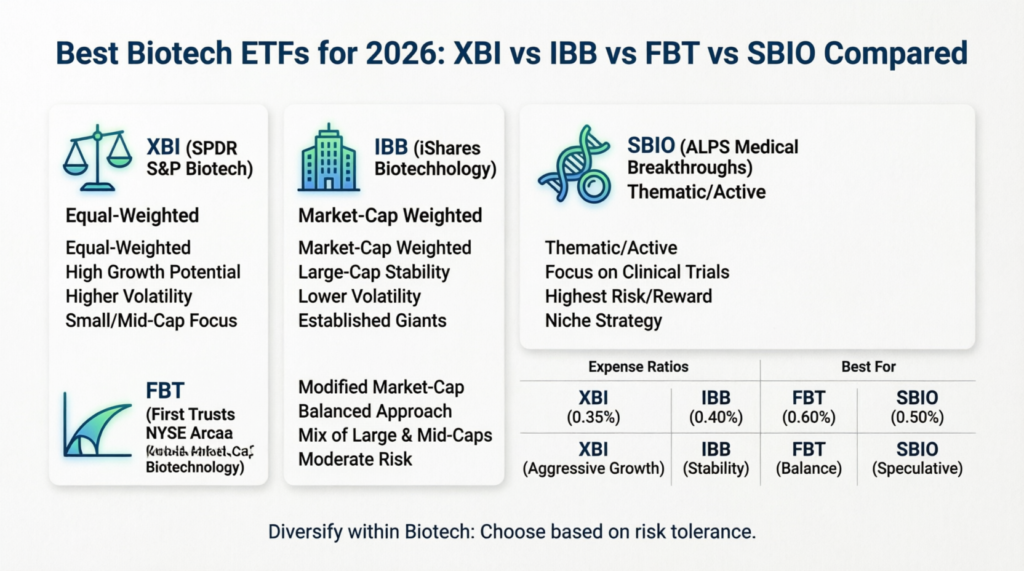
Two big biotech ETFs you’ll see are XBI (equal‑weight) and IBB (market‑cap weighted). The choice is not about “which is better”; it’s about which risk profile you want.
- Equal‑weight (XBI, FBT):
- Each stock gets roughly the same allocation, no matter its size.
- If you hold XBI with ~140–150 holdings, the top 10 positions might be ~8–10% of the fund, not 40–50%.
- You get more exposure to small‑ and mid‑caps, which can run fast on positive trial data but also implode on a Phase 3 miss.
- Market‑cap weighted (IBB):
- Big names like Amgen, Gilead, Regeneron, Vertex, Biogen, Eli Lilly, and Novo Nordisk dominate the index.
- These firms often generate cash and dividends, so IBB behaves more like a cash‑flow‑positive healthcare‑growth fund than a pure biotech punt.
If you want maximum small‑cap biotech kick, lean toward XBI or FBT.
If you want biotech with big‑cap ballast, lean toward IBB.
XBI vs IBB vs FBT vs SBIO vs ARKG
Here’s a 2026‑style snapshot of the best biotech ETFs most investors actually use.
1. XBI – SPDR S&P Biotech ETF (equal‑weight)
- Ticker: XBI
- Issuer: State Street / SPDR
- Expense ratio: 0.35%.
- Holdings: Roughly 140–150 biotech names, equal‑weighted.
- Sector mix: Small‑ and mid‑cap‑heavy; no giants like Eli Lilly or Johnson & Johnson.
- Performance context (April 2026):
- About +35% over the trailing 12 months.
- That’s well above the S&P 500, but with much higher volatility.
XBI is the classic “all‑small‑cap biotech” bet. If you want maximum exposure to trial‑readout‑driven moves, this is your tool.
2. IBB – iShares Biotechnology ETF (cap‑weighted)
- Ticker: IBB
- Issuer: BlackRock / iShares
- Expense ratio: 0.45%.
- Holdings: About 250+ biotech names, weighted by market cap.
- Big‑name slant:
- Positions in Gilead, Amgen, Regeneron, Vertex (VRTX), Biogen, Eli Lilly (LLY), Novo Nordisk (NVO), CRISPR Therapeutics (CRSP), and others.
- Performance context (April 2026):
- Roughly +30–35% over 12 months, slightly behind XBI but with lower volatility.
IBB is the “big‑pharma plus biotech” bridge. It’s less volatile than XBI but still carries heavy biotech risk.
3. FBT – First Trust NYSE Arca Biotech ETF (equal‑weight, small‑cap)
- Ticker: FBT
- Issuer: First Trust
- Expense ratio: Management fee 0.15% plus operating costs; MER closer to 0.55–0.73% depending on period.
- Holdings: 30 stocks, equal‑weighted, focused on small‑ and mid‑cap biotechs.
- Style:
- FBT is small‑cap‑only biotech, so it’s more narrow and volatile than XBI or IBB.
- One positive trial can move it +10–20% in a day; one failure can do the same in reverse.
FBT is for investors who want a concentrated small‑cap biotech slot inside an otherwise diversified portfolio.
4. SBIO – ALPS Medical Breakthroughs ETF (clinical‑stage)
- Ticker: SBIO
- Issuer: ALPS
- Expense ratio: Around 0.60–0.70%, depending on share class.
- Holdings: Roughly 90 stocks, each with one or more drugs in Phase 2 or Phase 3 trials.
- Index: S‑Network Medical Breakthroughs Index (PMBI).
- Caps: Only small‑ and mid‑cap names, typically $200M–$5B market cap.
SBIO is pure “near‑approval biotech”. You get no big‑cap ballast; you’re betting on FDA decisions and trial data.
5. ARKG – ARK Genomic Revolution ETF (gene‑editing focus)
- Ticker: ARKG
- Issuer: ARK Invest
- Expense ratio: 0.75%.
- Theme:
- Focused on genomic research, CRISPR, gene editing, immuno‑oncology, and next‑gen sequencing.
- Holds names like CRISPR Therapeutics (CRSP), Editas, Beam Therapeutics, Illumina, and related AI‑driven platforms.
- Risk level: Very high; ARKG can swing 10–20% on a single trial headline.
ARKG is not a biotech‑index ETF; it’s a thematic bet on gene‑editing and sequencing. It behaves more like ARKK than XBI or IBB.
Side‑by‑side best biotech ETFs table (2026)
| ETF | Ticker | Strategy Type | Holdings (approx.) | Expense Ratio* | 12M Return (2026) | Comment |
| XBI | SPDR S&P Biotech ETF | Equal‑weight, broad | 140–150 | 0.35% | ~+35% | Pure small‑cap biotech move |
| IBB | iShares Biotechnology ETF | Market‑cap weighted | 250+ | 0.45% | ~+30–35% | Big‑cap‑backed, less volatile |
| FBT | First Trust NYSE Biotech ETF | Equal‑weight, 30 | 30 | ~0.55–0.73% MER | ~+29% 1Y | Hyper‑concentrated; big swings |
| SBIO | ALPS Medical Breakthroughs ETF | Phase 2/3 clinical | 90 | ~0.60–0.70% | Light‑volume, volatile | Trial‑readout bet; no big‑caps |
| ARKG | ARK Genomic Revolution ETF | Thematic (CRISPR, genomics) | 30–40 | 0.75% | High‑beta, news‑driven | Thematic; not a core index |
*Always check the latest issuer fact sheet or prospectus; fees change.
Use this table as your cheat sheet when you open Fidelity, Charles Schwab, Vanguard, Robinhood, Webull, or M1.
How to position‑size biotech in your portfolio
Biotech is high‑beta satellite, not a core.
- Reasonable allocation band:
- Many research firms and multi‑asset shops use 0–5% of total portfolio for biotech ETFs, with 5–10% as a very aggressive tilt.
- Breakdown example (aggressive investor):
- 80% core – VTI, VOO, VXUS, BND, SCHD, SPY, QQQ, VNQ, AVUV.
- 10% sector – XBI + FBT + SBIO + ARKG packed into ~5–10% of total assets.
- Concrete band:
- Conservative: 0–2% combined biotech ETFs.
- Moderate: 2–5%.
- Aggressive: 5–10% (you must accept 30–50% drawdowns in a year).
If your stock sleeve is $100,000, a 5–10% biotech slice is $5,000–$10,000 spread across XBI, IBB, FBT, SBIO, ARKG, or a subset of them.
How to plug this into your investing plan
Biotech ETFs are not meant to replace your core of VTI, VOO, VXUS, BND, SCHD, VNQ, AVUV, SPY, or QQQ. They’re focused satellites that bet on FDA decisions, trial data, M&A, and innovation.
If you want to see how a 5–10% allocation to XBI, FBT, and SBIO would have behaved over the last 3–5 years compared to your core index‑fund stack, you can run the numbers in an Investment Growth Calculator that lets you mix VTI, VOO, and XBI, IBB, or FBT under different growth and volatility assumptions.
From here, your next step depends on your risk level:
- Just curious about biotech? → Start with a small 1–2% position in IBB or XBI in a taxable brokerage or IRA.
- Already hold VTI and VOO? → Layer in a 2–5% slice of XBI or FBT and treat it as a high‑risk satellite.
- Want to chase gene‑editing? → Use ARKG as a small, thematic bet (1–2% max), not the core of your biotech exposure.
invest1now.com publishes educational content, not personalized financial advice. Past performance does not predict future returns. Consult a licensed advisor before making investment decisions.