
If you’re hunting for the best biotech stocks 2026, you’re not just picking tickers; you’re betting on FDA decisions, Phase 3 trials, and big‑pharma M&A. The 10 names you’ll see most often in 2026 are Eli Lilly (LLY), Novo Nordisk (NVO), Vertex (VRTX), Regeneron (REGN), Amgen (AMGN), Gilead (GILD), Moderna (MRNA), BioNTech (BNTX), Axsome Therapeutics (AXSM), and CRISPR Therapeutics (CRSP).
You’ll walk away knowing:
- A plain‑English breakdown of each stock’s pipeline depth, key 2026 catalysts, cash runway, and valuation.
- The biggest risks on each play (trial failures, pricing pressure, biosimilar erosion, regulatory setbacks).
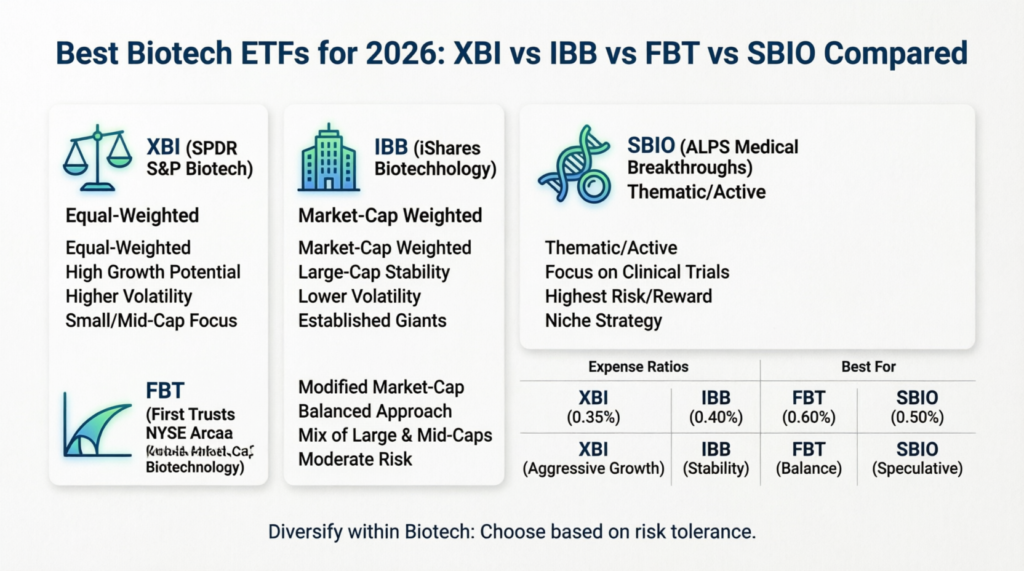
- How to size a biotech position next to core holdings like VTI, VOO, VXUS, BND, SCHD, SPY, QQQ, XBI, IBB, FBT, SBIO, ARKG, VNQ, AVUV, JEPI.
This is a 2026‑style, high‑volatility playbook, not a “buy‑and‑forget” list.
How to think about biotech risk in 2026
Biotech is not a slow‑and‑steady sector. One trial headline can move a stock ±15–40% in a day.
- Winners:
- Eli Lilly, Novo Nordisk, Vertex, CRISPR have all launched breakthrough assets (GLP‑1 obesity, CF, gene editing) and seen multi‑year runs.
- Losers:
- A Phase 3 failure or FDA rejection can erase 50% of market cap in hours.
Before you buy any of these names, you should:
- Know their next FDA PDUFA date.
- Understand whether they are cash‑flow positive or still burning cash.
- Decide your max allocation: most research shops cap dedicated biotech at 5–10% of your total equity portfolio.
Now, let’s walk through each of the top 10 biotech stocks to watch in 2026.
Large‑cap leaders: LLY, NVO, VRTX, REGN, AMGN, GILD
1. Eli Lilly (LLY) – GLP‑1‑driven giant
- Ticker: LLY
- Catalyst area: Obesity and diabetes (Mounjaro, Zepbound, other GLP‑1s).
- Pipeline depth:
- LLY is now the largest pharmaceutical company by revenue, with projected 2026 sales of $80–83B, up about 25% year‑over‑year.
- Between Lilly and Novo, roughly 20–25M patients currently use GLP‑1 drugs, and the long‑term obesity market could scale to hundreds of millions.
- 2026 milestones:
- U.S. GLP‑1 pricing pressure and access battles.
- Expansion into cardiometabolic, NASH, and obesity‑related indications.
- Cash & valuation:
- Cash‑flow positive; high single‑digit free‑cash‑flow yield with a P/E in the high‑teens to low‑20s, which is rich but justified by growth.
- Key risk:
- Pricing regulation, generic/biosimilar erosion later this decade, and safety‑and‑efficacy head‑to‑head vs Novo Nordisk.
LLY is not a “biotech punt”; it’s a blue‑chip with a biotech engine.
2. Novo Nordisk (NVO) – Ozempic and Wegovy
- Ticker: NVO
- Catalyst area: Semaglutide franchise (Ozempic, Wegovy, Rybelsus).
- Pipeline depth:
- 2025 sales from GLP‑1 products exceeded DKK 152.5B (~$23B USD) through Q3, with 9–23% YoY growth but slowing momentum.
- Wegovy now has cardiovascular, HFpEF, liver, and osteoarthritis indications, with an oral semaglutide pill under FDA review.
- 2026 milestones:
- FDA decision on oral Wegovy for obesity and CVD.
- Further label expansions and combo regimens.
- Cash & valuation:
- Profitable, with solid margins; trading at a P/E around low‑ to mid‑20s in 2026.
- Key risk:
- Competition from Eli Lilly, U.S. pricing pressure, and clinical safety updates (e.g., GI‑related events).
NVO is the European answer to LLY’s GLP‑1 dominance.
3. Vertex (VRTX) – Cystic fibrosis plus pain
- Ticker: VRTX
- Catalyst area: Cystic fibrosis franchise + pain / kidney pipeline.
- Pipeline depth:
- Vertex now has five approved CF therapies, with coverage in 60+ countries and ~95% of CF patients treatable by one of its drugs.
- In pain, Vertex is running Phase 3 programs for inaxaplin in chronic pain, with interim data due late 2026 or early 2027.
- 2026 milestones:
- Late‑2026 Phase 3 inaxaplin interim readout.
- Continuation of CF‑franchise royalty and revenue growth.
- Cash & valuation:
- Cash‑flow positive, with a P/E in the mid‑20s; balance sheet is strong and low‑debt.
- Key risk:
- Competitors in pain and kidney disease, and CF franchise patent‑cliff risk later in the decade.
VRTX is a “crown‑jewel” biotech with a proven track record of turning CF into a franchise.
4. Regeneron (REGN) – Eylea, Dupixent, Libtayo
- Ticker: REGN
- Catalyst area: Ophthalmology (Eylea) + oncology (Libtayo) + immunology (Dupixent).
- Pipeline depth:
- Eylea sales are declining due to biosimilar pressure, but Eylea HD (higher‑dose) grew 36% YoY in the U.S. in 2025 to $1.6B.
- Libtayo (PD‑1 checkpoint inhibitor) generated $1.1B in 2025, up 19% YoY, as it penetrates advanced skin and lung cancers.
- 2026 milestones:
- Eylea HD uptake and oncology readouts across Libtayo‑based combinations.
- Cash & valuation:
- Solid margins and strong free cash flow; P/E in the low‑20s.
- Key risk:
- Eylea biosimilar erosion, competition in immunotherapy, and pricing pressure in big indications.
REGN is a combination of cash‑cow and growth, not a pure‑start‑up biotech.
5. Amgen (AMGN) – Obesity drug MariTide
- Ticker: AMGN
- Catalyst area: Obesity (MariTide), oncology, and bone‑health portfolio.
- Pipeline depth:
- Amgen is running multiple Phase 3 trials of MariTide, a once‑monthly obesity injection, including a 72‑week study at three doses.
- Data from extended Phase 2 trials will be presented at the J.P. Morgan Healthcare Conference in early 2026.
- 2026 milestones:
- Phase 3 topline readouts and potential regulatory discussions with the FDA.
- Cash & valuation:
- Amgen is highly cash‑flow positive with a P/E in the low‑teens, making it cheaper than LLY or NVO.
- Key risk:
- MariTide safety and durability data, competition from LLY/NVO GLP‑1s, and biosimilar hits on legacy products.
AMGN is a value‑style biotech with a shot at a new GLP‑1‑like franchise.
6. Gilead (GILD) – HIV plus next‑gen antivirals
- Ticker: GILD
- Catalyst area: HIV, antivirals, and oncology.
- Pipeline depth:
- At J.P. Morgan 2026, Gilead highlighted seven HIV candidates and combinations in the pipeline, spanning treatment and PrEP with varied dosing strategies.
- They also have oncology assets (e.g., Trodelvy, others in late‑stage).
- 2026 milestones:
- Regulatory submissions and label expansions in HIV and cancer.
- Cash & valuation:
- Gilead carries a strong balance sheet and trades at a P/E in the low‑teens, with a dividend yield around 4%.
- Key risk:
- Pricing pressure on HIV drugs, biosimilar erosion, and limited pricing power in antivirals.
GILD is a defense‑style biotech with income and optionality.
Mid‑cap and catalyst‑rich: MRNA, BNTX, AXSM
7. Moderna (MRNA) – Cancer mRNA vaccines
- Ticker: MRNA
- Catalyst area: mRNA‑based oncology and infectious‑disease vaccines.
- Pipeline depth:
- Moderna ran 41 mRNA pipeline candidates in 2026, including personalized cancer vaccines and combo flu/COVID jabs.
- Its melanoma‑vaccine mRNA‑4157 plus Keytruda showed a 44% reduction in recurrence or death vs Keytruda alone in a Phase 2b trial.
- 2026 milestones:
- Regulatory review of mRNA‑1083 (flu/COVID combo).
- Phase 3 readouts for oncology‑focused candidates.
- Cash & valuation:
- MRNA is high‑beta; after its COVID surge, it now trades at a P/E in the high‑teens to low‑20s with a high price‑to‑sales multiple.
- Key risk:
- Platform trust; if key oncology trials fail, the multiple can compress sharply.
MRNA is a binary‑style play on mRNA‑oncology, not a core‑health‑care ETF.
8. BioNTech (BNTX) – Oncology pivot
- Ticker: BNTX
- Catalyst area: Oncology, mRNA‑based immunotherapies.
- Pipeline depth:
- BioNTech is executing a 2026 strategy toward becoming a multi‑product oncology company, with a diversified pipeline of immunomodulators, ADCs, and mRNA‑cancer vaccines.
- Several assets have pan‑tumor potential, spanning early‑ to late‑stage disease.
- 2026 milestones:
- Late‑stage readouts and regulatory filings across oncology.
- Cash & valuation:
- BNTX is volatile with a P/E in the mid‑20s; cash balance is solid but not blue‑chip‑like.
- Key risk:
- Competition from Moderna, Merck, and Roche in the mRNA‑cancer space.
BNTX is a speculative oncology‑platform bet.
9. Axsome Therapeutics (AXSM) – Alzheimer’s and depression
- Ticker: AXSM
- Catalyst area: Alzheimer’s disease agitation, major depressive disorder (Auvelity).
- Pipeline depth:
- The FDA set a PDUFA date of April 30, 2026 for Auvelity’s Alzheimer’s‑agitation indication, with priority review status.
- Analysts at Leerink see peak Auvelity sales potentially $2–3B across both depression and Alzheimer’s agitation.
- 2026 milestones:
- April 30, 2026 FDA decision on Auvelity for Alzheimer’s agitation.
- Cash & valuation:
- AXSM is small‑cap, with a high‑beta, deep‑value profile; P/E can flip between negative (until profit) and very high on good news.
- Key risk:
- FDA rejection or narrow label, safety issues, and low‑margin commercialization in a crowded CNS space.
AXSM is a classic binary‑event mid‑cap with one or two near‑term catalysts.
Gene‑editing pure‑play: CRISPR Therapeutics (CRSP)
10. CRISPR Therapeutics (CRSP) – Gene‑editing leader
- Ticker: CRSP
- Catalyst area: In‑vivo and ex‑vivo gene‑editing therapies (CASGEVY, oncology CAR‑Ts, others).
- Pipeline depth:
- CRISPR is pushing global CASGEVY commercialization, plus fresh regulatory submissions and readouts across in‑vivo and CAR‑T programs in 2026.
- 2026 milestones:
- Multiple clinical readouts and regulatory decisions; CASGEVY sales ramp in hemoglobinopathies.
- Cash & valuation:
- At about $56/share, CRSP trades at a price‑to‑book of roughly 2.8x, which is reasonable for a biotech but still speculative.
- Key risk:
- Off‑target‑editing concerns, small‑molecule and antibody‑based competition, and high R&D burn.
CRSP is the purest gene‑editing play on this list, and it’s a high‑volatility satellite, not a core holding.
How to size these in your portfolio
Biotech stocks are high‑beta satellites, not core.
- Reasonable total biotech bucket:
- Many multi‑asset shops cap biotech‑style exposure at 5–10% of your total equity portfolio.
- Example mix (equity portfolio of $100,000):
- $40,000–$60,000 – VTI, VOO, VXUS, BND, SCHD, SPY, QQQ, VNQ, AVUV, other index funds.
- $5,000–$10,000 – LLY, NVO, VRTX, REGN, AMGN, GILD, MRNA, BNTX, AXSM, CRSP mixed however you like.
If you want to see how a 5–10% allocation to LLY, NVO, MRNA, BNTX, and CRSP would have performed over the last 3–5 years relative to your core index‑fund stack, you can model it in an invest1now.com Growth Calculator that lets you input biotech‑stock returns and volatility separately.
From here, your next step depends on your risk level:
- Core‑focused? → Keep LLY, NVO, VRTX, REGN, and AMGN as small positions inside an otherwise diversified portfolio.
- Want higher upside? → Add **MRNA, B