
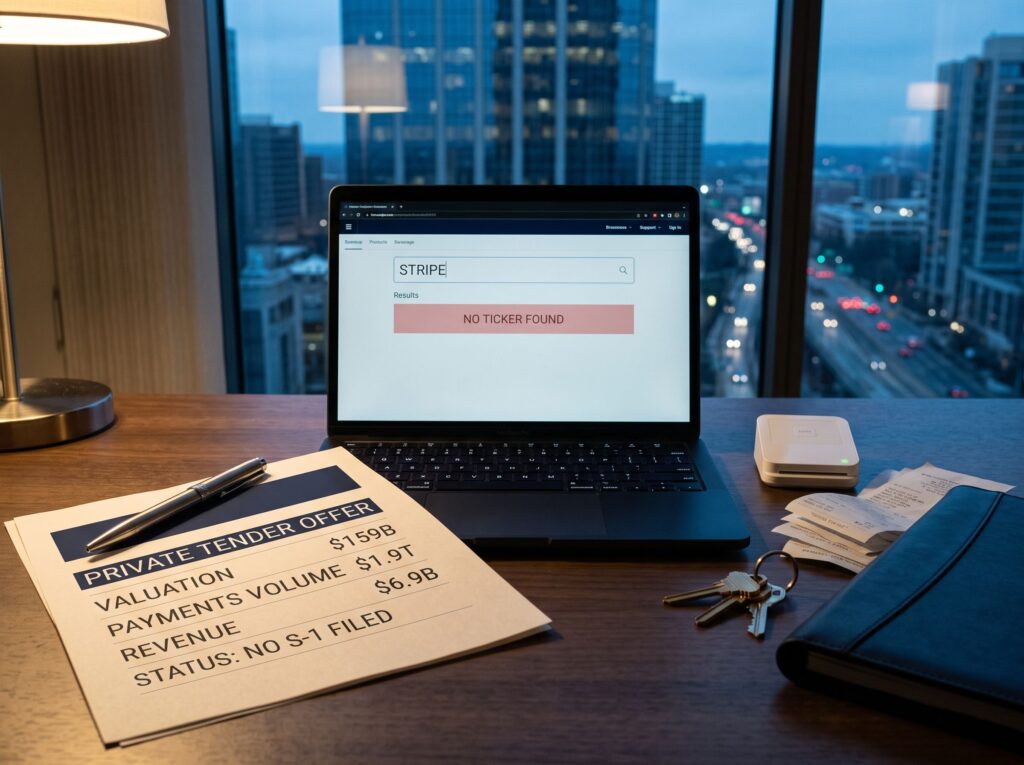
The short answer to is Stripe publicly traded is no. Stripe is a private company. There is no ticker symbol on the NYSE or Nasdaq, no S-1 registration statement on file with the SEC, and no confirmed IPO date. If you want to own a piece of Stripe today, you have to go through private market channels that are mostly reserved for accredited investors.
That frustrates a lot of people because Stripe is one of the most successful fintech companies in the world. It processed $1.9 trillion in payments in 2025, up 34% from the year before, which works out to roughly 1.6% of global GDP. Revenue hit $6.9 billion, and the company is profitable, with free cash flow of $3.2 billion. A company with those numbers would be a household name on the public market. Instead, it stays private and runs employee tender offers to give shareholders liquidity without going through the IPO process.
The short version: no ticker, no S-1, no IPO date. Stripe is valued at $159 billion and profitable, but management says a public listing is not a priority.
This guide answers the question directly, explains why Stripe is still private, shows how accredited investors can get Stripe pre-IPO exposure, and covers what we know about the Stripe IPO timeline. If you are looking for a way in, there are options. Just know they come with real trade-offs.
Is Stripe Publicly Traded?
No. Stripe is not publicly traded. It has never sold shares on a public stock exchange. As of today, Stripe has filed no S-1 registration statement with the SEC, named no underwriters, and reserved no ticker symbol.
That puts Stripe in a different category than companies like OpenAI or Anduril, which have either filed confidential drafts or signaled clear IPO intentions. Stripe leadership has actively downplayed the idea of going public. John Collison, the co-founder and president, told Bloomberg that going public is not one of the company top five or ten or twenty priorities. He added there was no rush for the company to list.
The company last major valuation event was a February employee tender offer that valued Stripe at $159 billion. That is a 70% jump from the roughly $91.5 billion valuation set in a similar tender offer a year earlier. The tender offer gave current and former employees a chance to sell shares, and it was backed by investors including Thrive Capital, Coatue, and Andreessen Horowitz.
But a tender offer is not an IPO. It is a private transaction. Stripe remains a private company, and there is no Stripe stock to buy on any public exchange. This is a different situation from a listed name you can look up and trade like any other of the stocks in a brokerage account.
Stripe has no S-1 on file, no IPO date, and management says a public listing is not a priority. Treat any product claiming to offer Stripe stock with caution.
Why Stripe Is Private
Stripe has stayed private for three main reasons: it does not need the money, it does not want the scrutiny, and its investors are patient.
The first reason is capital. Stripe has raised roughly $8.7 billion in total funding across its history, according to TechStackIPO data. It has not needed to tap public markets to fund operations or growth. The company generates strong free cash flow, and its private investors have been willing to fund tender offers that give employees liquidity without a listing.
The second reason is scrutiny. Public companies face quarterly earnings calls, detailed disclosure requirements, and constant market pressure. Stripe founders have built a long-term business and seem to prefer the flexibility of private ownership. The company dual headquarters in San Francisco and Dublin, its expanding product suite, and its push into stablecoins and AI commerce all benefit from the ability to make big bets without explaining every move to Wall Street every 90 days.
The third reason is investor patience. Stripe early backers, including Sequoia Capital, Andreessen Horowitz, and Founders Fund, have made enormous paper gains already. The company valuation has grown from $20 million at its 2011 seed round to $159 billion in the latest tender. There is no pressure from investors to force a liquidity event when the private market keeps delivering.
Stripe tender offers are a big part of this strategy. Instead of filing an S-1, Stripe periodically arranges sales where employees and early investors can sell shares to new private investors. The February tender at $159 billion was the latest in a series. A similar sale a year earlier valued the company at $91.5 billion, and prior tenders valued it at $65 billion and $70 billion. Those events give shareholders cash without the company going public.
| Tender Offer | Valuation | What It Means |
|---|---|---|
| Latest February tender | $159 billion | Up 70% year over year, backed by Thrive, Coatue, and a16z |
| Prior year tender | $91.5 billion | Same mechanism, no listing required |
| Earlier tenders | $65 billion and $70 billion | Liquidity for employees without a public market |
| 2011 seed round | $20 million | The starting point for the valuation run |
How to Gain Stripe Exposure
If you want Stripe pre-IPO exposure, there are a few paths. None of them are as simple as buying a stock. Each comes with different requirements, minimums, and risks.
For Accredited Investors
The most direct route is the secondary market. Platforms like Forge Global, Hiive (now called Clarity), and EquityZen connect buyers with existing Stripe shareholders, usually employees or early investors who want to sell. These platforms require you to meet the SEC accredited investor definition, which means a net worth over $1 million (excluding your primary home), annual income over $200,000 or $300,000 jointly, or a qualifying professional credential like the Series 7, 65, or 82 license.
Stripe shares on the secondary market have traded at prices implying valuations above $170 billion. Forge showed a price of $72.45 per share, Hiive showed $71.12, and Nasdaq Private Market showed $69.61. Those prices are above the $159 billion tender valuation, which suggests secondary buyers expect further appreciation.
| Platform | Minimum | Recent Per-Share Price |
|---|---|---|
| EquityZen | $5,000 select, $10,000 standard | Deal priced at launch, no live order book |
| Hiive, now Clarity | $25,000 | $71.12 |
| Forge Global | $100,000 direct | $72.45 |
| Nasdaq Private Market | Deal dependent | $69.61 |
One important detail: Stripe does not allow direct stock transfers in most cases. If you buy through a secondary platform, you will likely own a piece of a special purpose vehicle (SPV) that holds the shares, not the shares themselves. That adds a layer of structure risk. You need to read the documents carefully and understand what you actually own.
For Non-Accredited Investors
Your options are more limited. The most accessible route is the Destiny Tech100 fund (NYSE: DXYZ), a closed-end fund that holds pre-IPO stakes in companies including Stripe. It trades on the NYSE, so you can buy it in any brokerage account. The trade-off is that DXYZ trades at a premium to its net asset value, and Stripe is only one of several holdings.
Robinhood also launched a $1 billion closed-end fund that gives retail investors access to pre-IPO companies including SpaceX, Databricks, and Stripe. That fund is another indirect route for investors who are not accredited.
You can also get fintech exposure through public companies and ETFs. PayPal (PYPL) is a direct competitor in payments. The Global X FinTech ETF (FINX) and the ARK Fintech Innovation ETF (ARKF) hold baskets of fintech stocks. These are not Stripe, but they give you exposure to the same sector trends, and they often sit alongside the wider list of best investments ranked by risk-adjusted return.
Stripe does not permit direct stock transfers. Most pre-IPO access runs through SPVs or forward contracts, which means you own a piece of a fund, not the shares themselves.
If you are new to this market, our pre-IPO guide covers the basics of how these platforms work and who can use them. Our platform comparison breaks down the fees and minimums for Forge, Hiive, Clarity, EquityZen, and others.
IPO Timeline Speculation
Nobody knows when Stripe will go public. The company has given no public timeline. John Collison said an IPO is not a priority. No S-1 has been filed, no underwriters have been named, and no price range has been set.
That does not mean an IPO will never happen. Stripe has the scale, brand recognition, and investor profile that typically lead to a public listing. The company annual letter noted $1.9 trillion in payment volume and strong profitability. A company generating $6.9 billion in revenue and $3.2 billion in free cash flow would be one of the largest tech IPOs in history if it decided to list.
But the timing is uncertain. Credible scenarios range from a listing a couple of years out to no IPO at all. Stripe tender offers give employees and investors liquidity without the need for a public listing. As long as private capital is available and the company keeps growing, there is less pressure to go public.
A few things could change that calculation. If the private market for Stripe shares dries up, or if a major investor wants to exit, the company might reconsider. If a competitor like PayPal or Adyen gains ground, Stripe might want public currency for acquisitions. If the broader IPO market heats up and valuations are attractive, the founders might decide the time is right.
For now, the most definitive sign of an impending IPO would be an S-1 filing with the SEC. That document would provide the first look at audited financials, growth rates, and the specific risks Stripe faces as a public company. Until that happens, any talk of a Stripe IPO date is speculation.
The Bottom Line
Stripe is not publicly traded. There is no ticker, no S-1, and no IPO date. The company is valued at $159 billion after its latest tender offer, and it processed $1.9 trillion in payments in 2025. But it remains private, and management has said a public listing is not a priority.
Accredited investors can buy Stripe pre-IPO exposure through secondary marketplaces, usually through SPVs that hold the shares. Non-accredited investors have fewer options, but funds like DXYZ and the Robinhood closed-end fund give indirect access. Public fintech ETFs offer sector exposure without the private market risks.
If you want direct Stripe exposure, start by checking your accreditation status. If you qualify, compare the platforms and their fees. If you do not, look at the fund options. Either way, understand the risks before you invest, and check your asset allocation so one illiquid position does not dominate your portfolio. Stripe is a strong business, but pre-IPO investing is not the same as buying a stock on an exchange.
Frequently Asked Questions
Can I buy Stripe stock?
Not directly. Stripe is a private company with no publicly traded shares. Accredited investors can buy Stripe pre-IPO exposure through secondary marketplaces like Forge Global, Hiive or Clarity, and EquityZen. Non-accredited investors can get indirect exposure through funds like Destiny Tech100 (DXYZ) or the Robinhood closed-end fund, or through fintech ETFs like FINX and ARKF.
When will Stripe IPO?
No date has been set. Stripe has filed no S-1, named no underwriters, and given no timeline. Management has said an IPO is not a priority. Some analysts speculate about a listing a couple of years out or later, but there is no confirmed plan. The company tender offers give it flexibility to stay private for the foreseeable future.

