
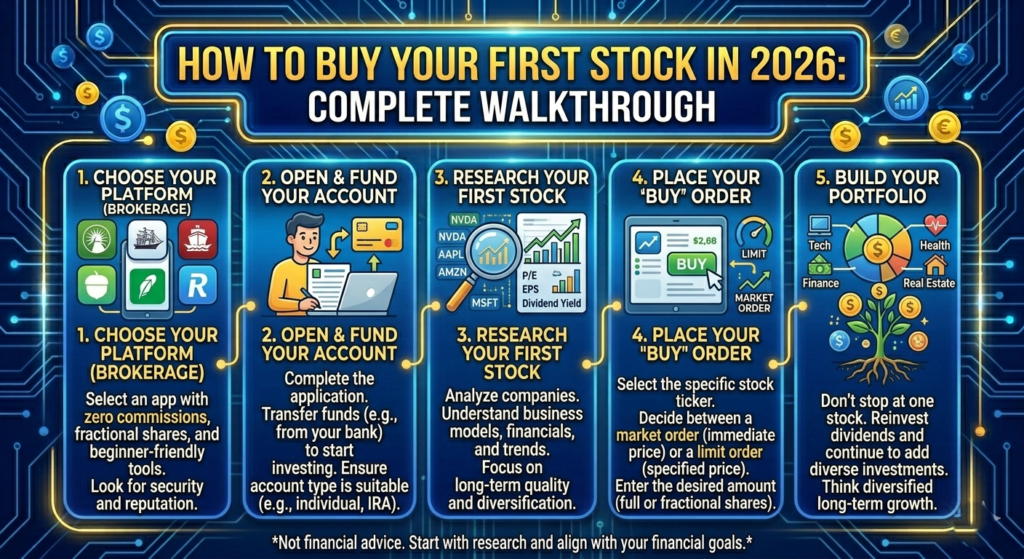
If you’ve ever stared at a brokerage screen and wondered how to buy stocks without screwing up, 2026’s process is actually simple and forgiving. You can open a brokerage account, fund it, and place your first trade in under 30 minutes, with very little paperwork. This page walks you through a complete, step‑by‑step how to buy your first stock in 2026:
- How to open a brokerage account (Fidelity, Charles Schwab, Robinhood, etc.).
- How to fund it (ACH, checks, wire).
- How to read a stock quote (bid/ask, last, volume, day range).
- How to pick an order type (market vs limit vs stop).
- How to choose how many shares (or use fractional shares).
- What happens after you confirm (T+1 settlement).
- What taxes you can expect when you sell.
- Why your first actual stock should be an ETF like VTI, VOO, or SCHD, not a speculative meme name.
You’ll learn how to do this at real brokers like Fidelity and Robinhood, with real ticks and fees, not “click here” fluff.
Step 1: Open a brokerage account (documents, time, choices)
Before you can buy stocks, you need a brokerage account that is registered with the SEC and FINRA. The most common beginner‑friendly platforms in 2026 are Fidelity, Charles Schwab, Robinhood, Webull, Vanguard, Public, SoFi, and M1 Finance.
What you’ll need to apply
To open a brokerage account, most brokers ask for:
- Basic ID: Government‑issued photo ID (driver’s license, passport, etc.).
- Social Security Number (SSN) or Tax ID.
- Personal information: Address, date of birth, employment status, investment goals.
- Bank details: For ACH funding (routing and account number).
No broker forces you to upload a death certificate; you just need valid ID, tax ID, and a bank account.
How long it takes
- Fidelity, Schwab, Robinhood, Webull, SoFi, Public, M1 Finance: Account can be approved and funded in 1–3 business days if everything checks out.
- Some platforms let you trade immediately once your identity is verified, even if your ACH deposit is still pending.
How to choose between Fidelity and Robinhood
- Fidelity or Schwab if you want strong research, retirement tools, and flexibility (Roth IRA, 401(k) rollovers, etc.).
- Robinhood if you want a sleek, mobile‑only interface with no commission on most stocks and ETFs.
You can always open a second account later; the first one is just to get started.
Step 2: Fund your brokerage account (ACH, wire, check)
Once your account is open, you need to move money in before you place a trade. The three main ways are:
- ACH bank transfer (most common).
- Wire transfer (faster, sometimes with fees).
- Check deposit (older, slower, sometimes with hold periods).
ACH funding (what 90% of beginners use)
- In your broker’s app, go to “Deposit” or “Transfer” and select “Transfer from bank.”
- Link your bank account by entering routing and account numbers.
- Choose how much to send (e.g., $100, $500).
- ACH typically settles in 1–3 business days; some brokers let you trade once they confirm the deposit pattern.
Wire transfer
- Use your broker’s wire instructions (usually found under “Deposit” → “Wire”).
- Your bank sends money directly to the broker’s custodial account.
- Wires often clear same‑day or next‑day, but some banks charge $10–$30 per wire.
Check deposit
- Some brokers still let you mail or scan a check.
- Processing time depends on post office mail and verification; it can take 5–10 business days.
Once your money settles in the account, you’ll see a cash balance that you can use to buy stocks.
Step 3: Search for a ticker symbol (and choose your first “stock”)
Every stock and ETF has a ticker symbol (e.g., VTI, VOO, SPY, SCHD, NVDA, AAPL). You need this to place an order.
How to search in Fidelity and Robinhood
- Fidelity:
- Tap “Trade” or “Buy” in the app, then type the ticker in the search bar.
- Fidelity will show you the full quote, order screen, and fractional‑share options.
- Robinhood:
- Open the app, tap “Trade,” then type the ticker in the search box.
- The stock or ETF page shows price, chart, news, and order panel.
What to pick for your first purchase
As a beginner, your first “stock” should usually be a broad ETF, not a single company. Examples:
- VTI – Vanguard Total Stock Market ETF (0.03% expense ratio).
- VOO – Vanguard S&P 500 ETF (0.03% expense ratio).
- SCHD – Schwab US Dividend Equity ETF (0.06% expense ratio, higher yield).
These give you instant diversification and lower risk than a single stock, while still letting you experience what it feels like to buy “a stock.”
Step 4: Read a stock quote (bid/ask, last, volume, day range)
Before you buy, you should know what the numbers on the screen mean. On Fidelity and Robinhood, the main quote pieces are:
- Bid: The highest price buyers are willing to pay right now.
- Ask: The lowest price sellers are willing to accept right now.
- Last (or “Last sale”): The price of the most recent completed trade.
- Volume: How many shares traded today.
- Day range: The lowest and highest prices for the stock today.
Why the bid/ask matters
- If you place a market order, you buy at or near the ask.
- If you place a limit order at or above the ask, you must decide how far above you’re willing to pay and wait for a match.
- The spread between bid and ask is one of your hidden costs, along with commissions and fees.
Step 5: Choose your order type (market vs limit vs stop)
Your broker will ask you to pick an order type. The three you’ll see most often are:
Market order
- Buys at the current best available price (near the ask).
- Pros: Fast, simple, always executes if the market is open.
- Cons: If the stock is volatile, you can pay a bit more than the “last” price.
Example:
- Apple (AAPL): Last price = $195. Ask = $195.10.
- If you place a market order for 1 share, you probably pay $195.10.
Best for beginners who want to keep it simple.
Limit order
- Buys only at or below a price you set.
- Pros: You control the maximum price; you never pay more than your limit.
- Cons: If the stock never reaches your price, the order doesn’t execute.
Example:
- AAPL last = $195, but you only want to pay $194.
- You place a limit order at $194. If the price never drops that low, the order stays open until it expires (day, GTC, etc.).
Stop order / Stop‑loss
- Trigger a market order when the price hits a level you set.
- Stop‑loss buy: Buys if the price rises to your stop; useful if you missed a breakout.
- Stop‑loss sell: Sells if the price falls to your stop; limits losses.
Example stop‑loss sell:
- You buy AAPL at $195.
- You set a stop‑loss at $180.
- If the price drops to $180, your broker sells at market, locking in a loss but preventing a bigger one.
For your first trade, market order is usually fine. Once you’re comfortable, experiment with limit orders.
Step 6: Decide how many shares (or use fractional shares)
Brokers now let you buy fractional shares, so you don’t need enough money for a full share of a $500‑priced stock.
Whole shares
- If you type “1 share”, you buy one full share at the current price.
- This works for cheaper stocks and ETFs like VTI, VOO, SCHD, which often trade under $100–$200 per share.
Fractional shares
- On Fidelity, Robinhood, Schwab, etc., you can often buy a dollar amount (e.g., $100 or $50) instead of a fixed number of shares.
- The platform calculates the fractional quantity for you.
Example:
- AAPL price = $195.
- You enter $100 in the “buy” box.
- You receive 100 ÷ 195 ≈ 0.513 shares of AAPL.
Fractional shares are great if you’re dollar‑cost averaging with small amounts each week or month.
Step 7: Place and confirm the order
Once you’ve chosen:
- Ticker (e.g., VTI).
- Order type (market).
- Quantity or dollar amount (1 share or $100 worth).
You hit “Buy” or “Review”, confirm the total cost, fees, and timing, then tap “Submit”.
What happens after you hit submit
- Your broker routs the order to an exchange or market‑maker.
- If you placed a market order, it usually fills instantly at the current price.
- If you placed a limit order, it may take seconds, minutes, or not fill at all depending on price.
In the app’s “Positions” or “Account” tab, you’ll see your new holding appear with the purchase price and date.
Step 8: Understand T+1 settlement (what happens when you sell)
In 2025 the U.S. switched to T+1 settlement for most equities:
- T+1 = Trade plus 1 day.
- When you sell a stock or ETF, the proceeds settle in 1 business day.
Example:
- You sell some VTI shares on Tuesday.
- The money appears as withdrawable cash on Wednesday (if markets are open).
This rule applies to:
- Stocks.
- ETFs.
- Options.
- Some bonds and listed mutual funds.
T+1 means you can’t instantly sell and withdraw the same day; plan funding moves accordingly.
Step 9: Know the tax implications of selling
Invest1now.com is not tax‑free; you will owe capital gains tax on profitable sales, depending on how long you hold.
Short‑term vs long‑term gains (2026 framework)
- Held 1 year or less → Short‑term capital gains.
- Taxed at your ordinary income rate (0%, 15%, 20% depending on your bracket).
- Held more than 1 year → Long‑term capital gains.
- Often taxed at 0%, 15%, or 20%, depending on your taxable income.
Example:
- You buy VTI for $100.
- You sell it a year later for $130.
- Your $30 gain is a long‑term capital gain and taxed at the long‑term rate.
You’ll receive a Form 1099‑B from your broker showing your sales, proceeds, and cost basis.
Wash‑sale rule warning
If you sell a stock at a loss and buy it back within 30 days, the IRS can disallow the loss under the wash‑sale rule.
- You still own the position, but the loss is deferred to the new cost basis.
What to buy as your first stock (ETF first, then blue‑chips)
If you’re asking how to buy your first stock in 2026, your answer is:
- Start with a low‑cost ETF like VTI, VOO, or SCHD in a Roth IRA or taxable brokerage.
- Once you’re comfortable with the process, add a blue‑chip stock (e.g., AAPL, MSFT, NVDA) as a smaller satellite.
Why this sequence
- Broad ETFs reduce the risk of a single‑company disaster.
- Blue‑chip stocks are still risky, but less volatile than small‑caps or meme names.
- Avoid penny stocks, 0DTE options, and meme coins for your first trade; they are gambling dressed as investing.
If you want to know how much an ETF like VTI has historically returned compared to single stocks

