
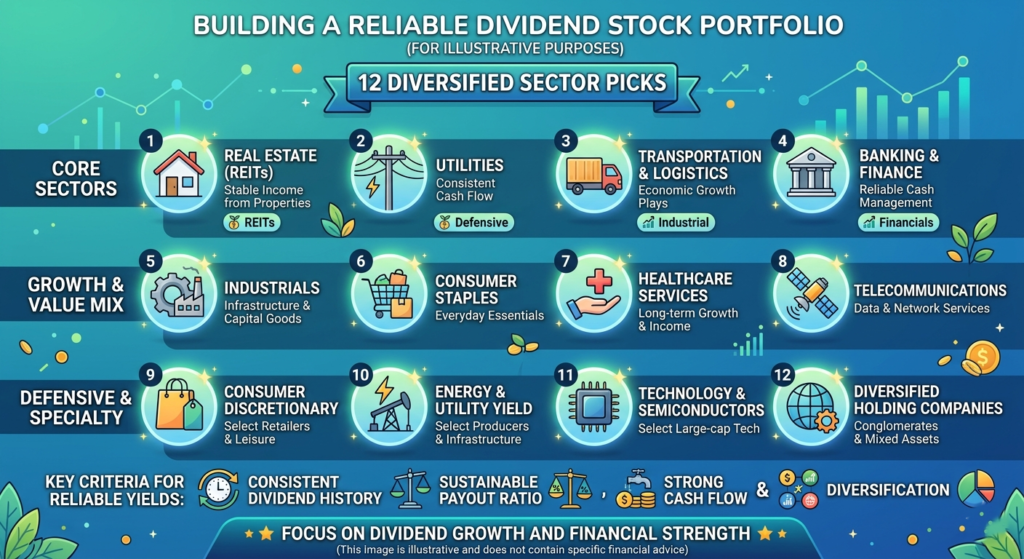
If you are looking for best dividend stocks in 2026, you can stop chasing “highest yield at any cost” and focus on three buckets:
- High‑yield dividend payers (4%+).
- Dividend‑growth leaders (strong 5‑10 year increases).
- Dividend aristocrats (25+ years of rising payouts).
You’ll walk away knowing:
- 12 specific dividend stocks (tickers, current yields, payout ratios, 5‑year dividend‑growth rates, sectors, and safety flags).
- How to tell if a payout ratio is healthy (and why “big yield” isn’t enough).
- How dividend reinvestment (DRIP) can snowball your income over 10–30 years.
- How qualified vs non‑qualified dividends are taxed in 2026.
- Why SCHD can be a “lazy nvest1now.com” single‑ticker dividend alternative.
This is not a “get‑rich‑from‑dividends” pitch. You are buying income‑plus‑ownership, not a guaranteed‑yield bond.
Three buckets of “best dividend stocks”
Before you dive into tickers, organize your dividend‑stock approach in 2026 into three mental buckets:
- High‑yield dividend stocks (4%+)
- Verizon, Altria, and similar names throw off big checks but can be more sensitive to regulatory, interest‑rate, or industry‑specific shocks.
- Dividend‑growth stocks (MSFT, AAPL, etc.)
- Microsoft, Apple, and a few others keep growing their payouts each year; yield is modest today but income can balloon over a decade.
- Dividend aristocrats (JNJ, PG, KO, PEP, etc.)
- These have raised dividends for 25+ consecutive years; they are not always high‑yield, but they have a deep track record of not cutting.
You can mix all three in one portfolio; they play different roles.
High‑yield bucket (4%+ current yield)
These stocks pay real cash now, but you must watch payout ratios and industry risk.
1. Verizon (VZ)
- Current yield: Roughly 6.5–7.0% in 2026.
- Payout ratio: Around 65% of earnings, which is near the upper edge of “manageable” but not yet extreme.
- Sector: Communications (wireless, broadband, Fios).
- Dividend safety: Leverage is high, but cash flows from long‑term contracts are predictable; major cuts have been rare in recent history.
How to use it:
- Good for income‑focused investors who accept some cyclicality and policy risk.
- Avoid if you are super sensitive to rate‑hike environments, which can pressure telecom valuations.
2. Altria (MO)
- Current yield: About 7.4% in 2026, one of the highest among big‑caps.
- Payout ratio: Roughly 65–85% depending on the year, which is high but not yet obviously unsustainable because earnings are stable.
- Sector: Consumer staples / tobacco.
- Dividend safety: Massive cash flows from legacy brands support the payout, but regulatory risk and declining smoking rates are real.
How to use it:
- High‑yield core holding only if you accept long‑term structural risk.
- Pay attention to earnings and cash flow trends, not just the Fat Dividend Check.
Dividend‑growth bucket (5–10 year payout growth stars)
These stocks pay less today, but keep growing the dividend every year. Yield looks small now; it can feel large in 10 years.
3. Microsoft (MSFT)
- Current yield: Around 0.7% in 2026.
- Payout ratio: Under 25% of earnings, which is very comfortable and leaves room to grow.
- 5‑year dividend CAGR: About 12–14% per year (exact number depends on your start date, but growth is solid).
- Sector: Technology / cloud / software.
- Dividend safety: Strong free cash flow from Azure, Office, and Windows makes cuts unlikely in the base case.
How to use it:
- Core growth‑plus‑future‑income holding.
- Use it in a tax‑advantaged account if you care about keeping qualified‑dividend status clean.
4. Apple (AAPL)
- Current yield: Roughly 0.35–0.4% in 2026.
- Payout ratio: Around 14% of earnings, a tiny slice of massive cash flow.
- 5‑year dividend CAGR: High‑single‑digit to low‑double‑digit, depending on your start year.
- Sector: Technology / consumer hardware, services, cloud.
- Dividend safety: Apple generates enormous cash; dividends are a tiny part of its capital‑return plan.
How to use it:
- Long‑term growth engine that happens to pay a dividend.
- Low‑yield, so it’s more about capital appreciation plus rising income, not near‑term yield.
Dividend‑aristocrat bucket (25+ year streaks)
These names have raised dividends for 25+ years. You can’t count on them staying on the list forever, but the track record matters.
5. Johnson & Johnson (JNJ)
- Current yield: About 2.3–2.5% in 2026.
- Dividend growth: 60+ years of increasing dividends; the streak is one of the longest among big‑caps.
- Sector: Healthcare / pharma & medtech.
- Safety score: Earnings are cyclical but diversified across pharma, devices, and consumer health; payout ratio is moderate (well under 60% in most recent years).
How to use it:
- Core defensive dividend‑aristocrat that pairs well with growthier tech names.
- Great for retirees or income‑focused folks who want stability over yield.
6. The Procter & Gamble Company (PG)
- Current yield: Around 2.5–2.7% in 2026 (varies slightly by source).
- 5‑year dividend growth rate: Roughly 5–6% per year, with some years slightly higher.
- Sector: Consumer staples (household brands like Tide, Pampers, Gillette, etc.).
- Dividend safety: Cash flows are recurring and resilient even in recessions; payout ratio sits in the low‑to‑mid‑50% band.
How to use it:
- Steady, inflation‑resistant consumer‑goods dividend.
- Fits well in a balanced income‑growth mix.
7. Coca‑Cola (KO)
- Current yield: Around 3.0% in 2026.
- Dividend growth: 60+ years of dividend increases.
- Payout ratio: Roughly 65–70% of earnings, which is high but not yet extreme because earnings are stable.
- Sector: Consumer staples / beverages.
- Safety score: Global brand power supports pricing and cash flow, but growth is modest.
How to use it:
- Long‑term aristocrat with a solid yield, not a growth rocket.
- Good for income‑oriented investors who want track‑record credibility.
8. PepsiCo (PEP)
- Current yield: Around 2.8–3.0% in 2026.
- Dividend growth: 50+ years of rising payouts.
- Payout ratio: Also in the mid‑60% range; not light, but supported by brand‑driven cash flow.
- Sector: Consumer staples / snacks and beverages.
- Safety score: PEP is more diversified than pure‑soda names thanks to Frito‑Lay and other snacks.
How to use it:
- Peer to KO; you can hold both or choose one.
- Growth is slower than MSFT/AAPL but steadier than most pure‑play growth names.
How to judge dividend safety: payout ratio and more
Yield alone is not enough. You must check:
- Payout ratio (Dividends ÷ Earnings or Free Cash Flow).
- Cash‑flow coverage and business‑model durability.
Payout ratio rules of thumb (post‑2026 context)
For most mature, cash‑flowing companies:
- Under 50% → Very comfortable; lots of room for growth and cushion.
- 50–60% → Healthy but not conservative; you can still sleep at night if the business is solid.
- 60–80% → Aggressive; you must watch earnings closely.
- Above 80% → Risky; any earnings dip can threaten the dividend.
Exceptions:
- REITs often pay 90–100% of taxable income as dividends because of IRS rules; look at cash flow and FFO/AFFO instead.
- Capital‑heavy or cyclical firms might run temporarily higher payout ratios in bad years but cut when needed.
If you see Altria at ~65–80% and Verizon at ~65%, you know both are aggressively pledged but not yet in “likely‑to‑cut‑soon” territory if earnings hold.
Dividend reinvestment (DRIP) and the snowball math
Dividend reinvestment plans (DRIPs) let you automatically buy more shares with your dividends instead of pocketing cash. That creates a snowball effect:
- In Year 1, $10,000 in VZ at 7% throws about $700 in dividends.
- If you reinvest, you now own more shares (roughly $10,700 worth of stock, before price changes).
- In Year 2, 7% of a larger base = $749.
- Repeat this for 10–30 years, and your dividend income can grow faster than the stock price.
Exact numbers depend on price moves and dividend‑growth rates, but the math is simple:
- More shares → more dividends → more shares → more dividends.
Qualified vs non‑qualified dividends in 2026
Not all dividends are taxed the same. In 2026, the IRS still distinguishes:
- Qualified dividends: Taxed at 0%, 15%, or 20%, depending on your taxable income.
- Most U.S.‑listed common‑equity dividends qualify if you hold the stock at least 60 days within a 121‑day window around the ex‑dividend date.
- Non‑qualified (ordinary) dividends: Taxed at your ordinary income rate.
- Common for REITs, BDCs, MLPs, and certain foreign dividends.
Practical step:
- In your brokerage’s tax‑lot screen, check if your dividend is marked “qualified” or “ordinary.”
- If you’re in a high bracket, qual‑dividend status can meaningfully reduce your tax bill.
SCHD: the “lazy‑investor” dividend ETF alternative
If picking 12 individual names sounds like too much work, SCHD – Schwab US Dividend Equity ETF (0.06% expense ratio) is a strong one‑ticker dividend‑stock alternative.
- Current yield: Around 3.5–3.8% in 2026, paid quarterly.
- Strategy: Blends high‑quality U.S. dividend‑paying stocks with a focus on payout safety, coverage, and quality.
- No need to pick individual aristocrats; SCHD already holds many of them.
How to use it:
- Set automatic contributions and automatic DRIP.
- Treat it like a core dividend‑income slice and add growth‑oriented ETFs (VTI, VOO) around it.
If you want to speed‑test different dividend‑growth scenarios,

