
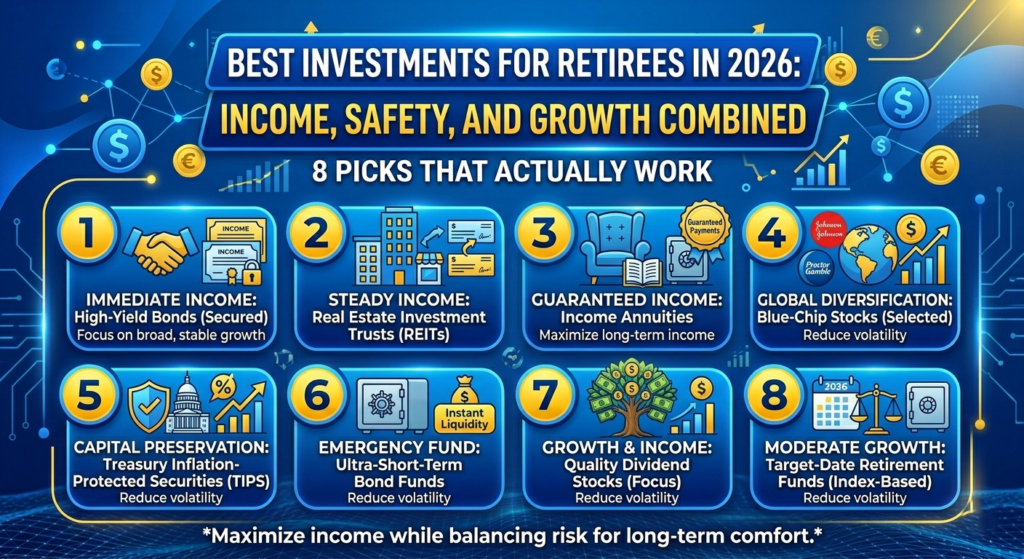
The biggest mistake many retirees make is assuming retirement means switching to “no‑risk” and giving up too much growth. In 2026, the real goal is capital preservation, income generation, inflation protection, and longevity risk management—not just chasing the highest yield or hiding everything in cash. This guide shows you how to balance safe investments for seniors with total‑stock exposure for growth so you don’t turn your portfolio into a guaranteed‑income-only machine that gradually loses value to inflation.
You’ll leave this page understanding:
- Why the classic 4% rule is under debate and how to adjust it for 2026.
- How to build a 5‑year Treasury bond ladder and use it for stable, predictable income.
- Which dividend ETFs (SCHD, VYM, DGRO) can enhance income without exploding risk.
- The pros and tax cons of covered‑call ETFs like JEPI and JEPQ.
- When a single‑premium immediate annuity (SPIA) might make sense.
- How Series I Bonds, REITs (O, VNQ), and a small slice of total stock market (VTI) fit into a retiree portfolio.
- What RMD rules under SECURE Act 2.0 mean for you (RMD age now 73 in 2026, moving to 75 in 2033).
If you enter Retirement Portfolio Builder or similar, you can plug in your actual numbers and see how these pieces fit your situation.
The retiree problem: safety, income, inflation, and longevity
Once you’re past 60, your money serves four main jobs:
- Preserve capital so you don’t wipe out your savings in a bear market.
- Generate steady income to cover monthly bills plus small luxuries.
- Keep up with inflation so your purchasing power doesn’t drift down.
- Last for 25–30+ years (longevity risk), especially if you’re healthy and active.
If you park everything in cash or ultra‑short bonds, you may be safe in the short term but lose ground to inflation over a decade. If you hold 100% stocks, you risk a big drawdown right when you need cash. The sweet spot for most retirees is consistent income with a moderate growth tilt, not yield‑chasing at all costs.
Bond ladders: 5‑year Treasury ladder example
A bond ladder is a set of bonds that mature at different dates so you always have predictable income and reinvestment flexibility. For retirees, a 5‑year Treasury ladder is a common starting point.
How a 5‑year ladder works
Imagine you have $100,000 to allocate across Treasuries that mature in 2026, 2027, 2028, 2029, and 2030. Each year, one rung matures and you can either:
- Spend the cash (income).
- Reinvest at the current 5‑year Treasury rate.
If the 5‑year Treasury yield is around 4–4.5% in 2026, you are earning a modest yield while keeping durations short and interest‑rate risk low.
How to build this at your broker
You can buy individual Treasuries or use a bond‑ladder‑style mutual fund/ETF at brokers like Fidelity, Schwab, or Vanguard. For example:
- Vanguard Short‑Term Treasury ETF (SBB) or Vanguard Intermediate‑Term Treasury ETF (VGIT) can approximate the ladder concept.
- Or you can buy specific Treasury notes (1‑, 2‑, 3‑, 4‑, 5‑year maturities) through your broker’s bond‑desk workflow and hold them to maturity.
Each year, you sell or let the shortest‑maturity bond mature and reinvest into a new 5‑year note, keeping the ladder intact.
Dividend ETFs for retirees (SCHD, VYM, DGRO)
Dividend ETFs can boost income while keeping you diversified. Three widely held options for retirees in 2026 are:
- SCHD – Schwab US Dividend Equity ETF (expense ratio 0.06%)
- Holds 100 high‑quality U.S. dividend‑paying companies, tilted toward stable sectors like industrials, financials, and consumer goods.
- Snapshot yield roughly 3.8–4.0% in 2026, with 5‑year dividend‑growth rate in the high‑single‑digit range.
- VYM – Vanguard High Dividend Yield ETF (expense ratio 0.04%)
- Focuses on higher‑yield U.S. dividend payers across multiple sectors.
- Snapshot yield around 2.3–2.4% in 2026; dividends grew roughly 3.8% annually over the past 5 years, but growth has slowed recently.
- DGRO – iShares Core Dividend Growth ETF (expense ratio 0.08%)
- Tracks U.S. stocks that have raised dividends for at least 5 consecutive years.
- Snapshot yield around 2.0–2.1% in 2026, with stronger long‑term dividend‑growth focus than pure high‑yield funds.
How these fit in a retiree portfolio
- SCHD is a “core” income‑plus‑quality holding with a higher yield than broad‑market ETFs.
- VYM boosts current income but has lower dividend growth; it can feel like a yield‑heavy satellite.
- DGRO is better for retirees who care more about growing income over time than squeezing every dollar of today’s yield.
If you hold these in taxable accounts, you can often benefit from qualified‑dividend tax rates (0%, 15%, or 20% depending on your bracket).
Covered‑call ETFs: JEPI and JEPQ
Covered‑call ETFs like JEPI and JEPQ sell call options on their underlying stocks to generate extra premium income, which shows up as higher distributions. That makes them attractive for retirees seeking yield, but the tradeoffs are real.
JEPI – JPMorgan Equity Premium Income ETF
- Expense ratio: 0.35%.
- Uses a low‑volatility S&P 500‑like basket plus equity‑linked notes (ELNs) that mimic one‑month covered calls.
- Typical distribution yield roughly 7–9% in today’s environment, but distributions are taxed as ordinary income, not qualified dividends.
JEPQ – JPMorgan Nasdaq Equity Premium Income ETF
- Expense ratio: 0.35%.
- Writes covered calls on Nasdaq‑100 growth stocks, so you get higher options premiums but also higher volatility.
- Typical yield in the 9–11% ballpark, with the same ordinary‑income tax treatment for distributions.
What to watch
- Yield is attractive but not “risk‑free”; these funds can underperform plain equity ETFs in strong bull markets because they cap upside.
- In taxable accounts, the ordinary‑income treatment cuts into the advantage if you’re in a high bracket.
- They fit best as satellites, not your entire equity slice.
Single‑premium immediate annuities (SPIAs)
A single‑premium immediate annuity (SPIA) lets you trade a lump sum for a guaranteed, lifelong income stream. You pay the insurance company once (the “single premium”), and in exchange they mail you a check every month for life (or for a fixed period).
Why retirees use SPIAs
- Guaranteed payments reduce the risk of outliving your money (longevity risk).
- You can pair them with a 4%+ initial payment rate in 2026, depending on your age, gender, and interest‑rate environment.
- Some policies let you add inflation adjustment (COLA) at a lower initial payout.
Tradeoffs
- You lose access to the principal. If you need a big lump sum later, it’s hard to get it back.
- Payments are partially taxable; the taxable portion depends on your life expectancy and purchase context.
- Annuities are insurance products, not simple ETFs; you should read the policy language and compare multiple providers before committing.
SPIAs work best for retirees who have other liquid assets and want to lock in a core floor of income that cannot be out‑earned by market returns.
Series I Bonds for retirees
Series I Savings Bonds are inflation‑indexed U.S. Treasury bonds that pay a fixed rate plus a variable inflation‑indexed rate every six months. For 2026, the composite rate for I bonds issued November 1, 2025 through April 30, 2026 is 4.03% per year, made up of a 0.90% fixed rate and 1.56% semiannual inflation component.
How retirees can use them
- Minimum purchase: $25 per bond at TreasuryDirect.gov.
- Annual limit: $10,000 in electronic bonds plus $5,000 in paper bonds via tax refund.
- Hold at least one year; cash before five years and you lose the last three months of interest.
I bonds fit well as a low‑volatility, inflation‑hedged layer of your fixed‑income stack. They are not traded on the secondary market, so you can’t flip them for a quick gain.
REITs: Realty Income (O) and VNQ
Real‑estate investment trusts (REITs) let retirees earn rental‑like income without owning physical property. Two popular options are:
- Realty Income (O) – a “monthly dividend” real‑estate company that mainly owns freestanding retail and commercial properties.
- Snapshot yield around 6–7% in 2026, with monthly payouts.
- REITs face interest‑rate risk; rising rates can pressure property valuations.
- VNQ – Vanguard Real Estate ETF (expense ratio 0.13%)
- Holds over 150 U.S. REITs across retail, offices, apartments, malls, data‑center REITs, etc.
- Snapshot yield roughly 3.9–4.0% in 2026, with distributions taxed as ordinary income plus some return‑of‑capital portions.
How to size REIT exposure
- REITs add income and diversification but also sensitivity to interest rates and real‑estate cycles.
- Many retirees keep them as 5–10% of the total portfolio, not a core bond substitute.
Keeping growth alive: total stock market (VTI)
Retirees sometimes ditch growth entirely and pile into bonds. That can be a mistake because inflation nibbles away at 2%‑yield bonds over 20 years. A modest slice of equities, like the Vanguard Total Stock Market ETF (VTI), helps hedge inflation.
- VTI holds all U.S. stocks in one low‑cost package, with an expense ratio of 0.03%.
- Its yield is light, around 1.1% in 2026, so it is not a primary income tool, but it provides long‑term capital appreciation.
In a retiree portfolio, VTI can sit as a 20–30% equity slice, paired with bond ladders, dividend ETFs, and REITs.
The 4% rule debate in 2026
The classic 4% rule suggests you can safely withdraw 4% of your portfolio per year, adjusted for inflation, without a high chance of running out over 30 years. In 2026, that rule is being questioned because:
- Bonds yield more than they did in 2020, easing the strain on equity withdrawal rates.
- Sequence‑of‑returns risk is still real: if you hit a big bear market in the first few years of retirement, 4% may be too aggressive.
Many advisors now lean toward:
- 3–3.5% base withdrawal rate for conservative retirees.
- 3.8–4.2% for those with flexible spending and the ability to cut back in down markets.
You can test this yourself in the Retirement Withdrawal Calculator on this site by plugging in your portfolio size and withdrawal rate.
RMDs under SECURE Act 2.0 (age 73, moving to 75)
If your money sits in traditional IRAs, 401(k)s, or other qualified retirement accounts, you must take Required Minimum Distributions (RMDs) once you hit the RMD age. Under SECURE Act 2.0, the rules are:
- Age 73 in 2026 for people born after 1950.
- Age 75 starting in 2033 for those born in or after 1959.
RMDs are calculated using your account balance at year‑end and an IRS life‑expectancy table. If you miss an RMD, you face a 25% penalty on the shortfall (waivable in certain hardship cases).
Strategies around RMDs include:
- Roth conversions earlier in retirement to heat‑up growth‑inside‑tax‑free accounts and reduce future RMDs on traditional IRAs.
- Strategic withdrawals from taxable accounts first, then traditional IRAs, turning on RMDs only when required.
Sample retiree portfolios (2026)
Below are two example allocations for retirees who want income, safety, and modest growth. These are illustrative starting points, not personalized advice.
$500,000 retiree portfolio (balanced income + growth)
| Asset type / example | Suggested allocation | Role in the portfolio |
| 5‑year Treasury bond ladder (individual notes or short‑term Treasury ETFs) | 30% ($150,000) | Low‑volatility, predictable income; reinvest maturities to keep ladder |
| Dividend ETFs (SCHD, VYM, DGRO mix) | 20% ($100,000) | Boost income with qualified‑dividend exposure |
| REITs (VNQ, O) | 10% ($50,000) | Rental‑like income plus inflation hedge |
| Covered‑call ETFs (JEPI or JEPQ) | 5% ($25,000) | Extra income satellite, taxable‑account‑friendly if in lower brackets |
| Single‑premium immediate annuity (SPIA) | 10% ($50,000) | Locked‑in lifetime income floor |
| Series I Bonds (TreasuryDirect) | 10% ($50,000) | Inflation‑protected, low‑risk, must‑hold cash |
| Vanguard Total Stock Market (VTI) | 15% ($75,000) | Growth and inflation‑hedging equity slice |
This mix keeps roughly 60% in income‑oriented, lower‑risk assets and 15–20% in equities for growth, with annuity and bond‑ladder income covering a solid base of monthly needs.
$1M retiree portfolio (larger income base)
| Asset type / example | Suggested allocation | Role in the portfolio |
| 5‑year Treasury bond ladder | 30% ($300,000) | Same role as above, larger income base |
| Dividend ETFs (SCHD, VYM, DGRO) | 20% ($200,000) | Stronger dividend stream |
| REITs (VNQ, O) | 10% ($100,000) | meaningfully higher rental‑like income |
| Covered‑call ETFs (JEPI, JEPQ) | 5% ($50,000) | Extra yield where appropriate |
| SPIA (one or more policies) | 10% ($100,000) | Bigger guaranteed monthly floor |
| Series I Bonds | 5% ($50,000) | Inflation‑buffer, low‑risk stash |
| VTI (U.S. total market) | 20% ($200,000) | Growth‑engine portion |
With more assets, you can thicken certain slices (more annuity, more bonds, more REITs) while keeping the same logical structure.
What to do next
If you’re a retiree in 2026, you do not need to choose between total safety and all‑out growth. You can build a **balanced mix of bond ladders,

