
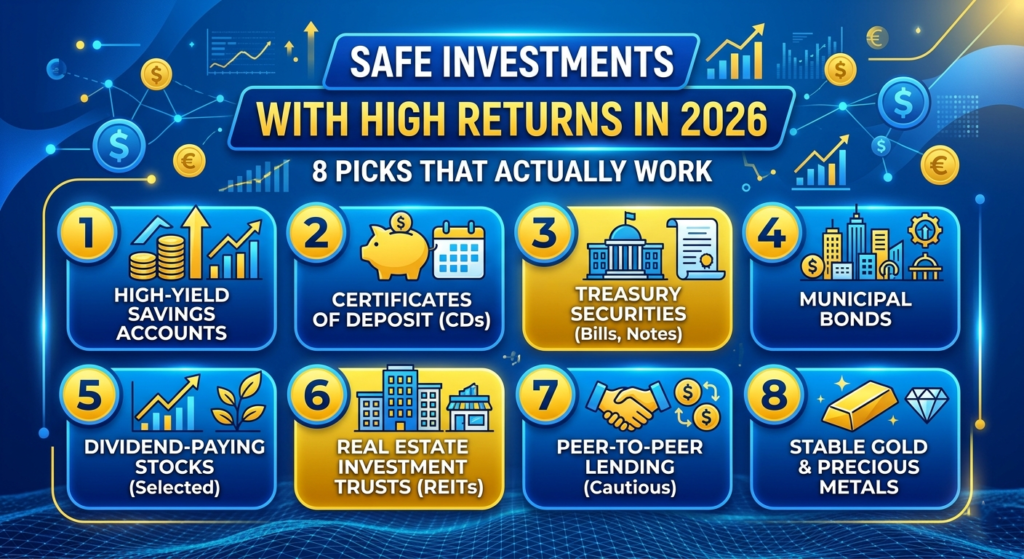
If you’re looking for safe investments with high returns, you’re not alone. Most people want to earn more than 0.01% without turning their portfolio into a casino. In 2026, “safe” no longer means 0% and it’s not the same as guaranteed. You can get decent yields with calculable risk, but you must understand what “safe” actually means:
- FDIC/NCUA‑insured products (bank accounts, CDs).
- Principal‑protected securities (Treasury bills, Series I bonds, most money‑market funds).
- Low‑volatility assets (short‑duration bond funds, AAA‑rated corporate bonds, dividend‑aristocrat ETFs).
You’ll walk away knowing:
- How to rank low risk, high‑yield options in 2026.
- The current ballpark yields, minimums, lockups, and tax rules for each pick.
- Where to buy them (Fidelity, Schwab, Vanguard, TreasuryDirect, etc.).
- How to build a 3‑tier “safety stack” (cash → bonds → dividend equity) that fits your risk level.
What “safe investments with high returns” actually means in 2026
After Fed rate cuts in 2025 and more projected in 2026, yields have come down from their 2023–24 peak. Many 4%+ CD and high‑yield savings account rates are now trending toward 3–3.5% unless you chase longer maturities or special products. That does not mean you should park everything in cash, but it does mean you can’t expect 6–8% with zero risk anymore.
For this page:
- “Safe” = FDIC/NCUA‑insured, or principal‑protected via government/AAA‑rated debt, or low‑volatility equity.
- “High returns” = above typical savings‑account levels, given today’s 3–4% baseline.
We’ll order each pick by approximate yield, then explain where it fits in your personal safety stack.
1. Treasury bills (T‑bills) and short‑term ETFs (SGOV, BIL)
Treasury bills are short‑term U.S. government debt with maturities from a few days up to one year. They are backed by the full faith and credit of the U.S., which is about as “safe” as you can get for principal‑protected instruments.
Current environment (2026)
- The 10‑year Treasury yield sits around 4.3% as of April 2026.
- Short‑term T‑bills are lower, but still competitive with savings‑account rates once you account for tax‑efficiency and liquidity.
How to buy T‑bills
You have two main routes:
- Direct via TreasuryDirect.gov
- Create an account, link a bank, and buy T‑bills in $100 increments.
- You can choose maturities like 4‑week, 13‑week, or 26‑week bills.
- You earn price appreciation plus the interest spread at maturity.
- Via ETFs on your broker (Fidelity, Schwab, Vanguard, Robinhood, Webull, etc.)
- SGOV – iShares 0–3 Month Treasury Bond ETF (expense ratio 0.05%).
- BIL – SPDR Bloomberg 1–3 Month T‑Bill ETF (expense ratio 0.14%).
- Both trade like stocks and reinvest proceeds automatically.
Tax and practical notes
- Coupons on T‑bills and T‑bill ETFs are exempt from state and local income tax, though you still owe federal income tax.
- Minimums: $100 per bill at TreasuryDirect, or $1 per share if you buy SGOV/BIL via fractional‑share brokers.
- Lockup: No true lockup; you can sell SGOV/BIL intraday, or hold T‑bills to maturity.
For many investors, SGOV is the cleanest way to park “safe” dollars that may rotate into stocks later.
2. Series I Savings Bonds
Series I Savings Bonds are inflation‑indexed U.S. Treasury bonds that pay a fixed rate plus a variable inflation‑linked rate, reset every six months. The current composite rate for I bonds issued November 1, 2025 through April 30, 2026 is 4.03% per year, made up of a 0.90% fixed rate and 1.56% semiannual inflation rate.
How they work
- You buy them at face value (no premium/discount).
- They earn interest for up to 30 years or until you cash them in.
- Interest is compounded semiannually and added to the bond’s value every six months.
Minimums, lockups, and limits
- Minimum purchase: $25 via TreasuryDirect.
- Maximum annual purchase: $10,000 in electronic I bonds (TreasuryDirect), plus $5,000 in paper I bonds via tax refund.
- Minimum hold: One year; if you cash them before five years, you lose the last three months of interest.
Where to buy and tax impact
- Only at TreasuryDirect.gov; no broker‑based I‑bond platform.
- Interest is exempt from state and local income tax and can be federal‑tax‑free if used for qualified education expenses (with income limits).
Series I bonds are a low‑volatility hedge against inflation, not a trading vehicle. They fit best in a “core cash‑like” layer of your safety stack.
3. Money‑market funds (SPAXX, VMFXX, FZFXX, SWVXX)
Money‑market funds hold short‑term, high‑quality debt (Treasury bills, government agency paper, top‑rated corporate paper) and aim to keep a stable net asset value around $1 per share. They are not FDIC‑insured, but they are highly unlikely to break the dollar thanks to strict regulatory limits on maturity and credit quality.
Key funds and 2026 yields
- VMFXX – Vanguard Federal Money Market Fund Investor
- Tracks short‑term U.S. government debt.
- Dividend yield around 4.0% in early 2026.
- SPAXX – Fidelity Government Money Market Fund
- Sits behind Fidelity’s fast‑cash sweep; similar yield band to VMFXX when you log into Fidelity.
- FZFXX – Fidelity Prime Money Market Fund and SWVXX – Schwab Value Advantage Money Market Fund behave the same way for Fidelity and Schwab cash accounts.
How to buy and use them
- You usually don’t buy these as separate trades.
- When you open a brokerage or mutual‑fund account at Fidelity, Schwab, Vanguard, or similar, your uninvested cash automatically sweeps into the house money‑market fund (SPAXX at Fidelity, VMFXX at Vanguard, SWVXX at Schwab).
- You can also buy VMFXX directly in a Vanguard brokerage or mutual‑fund account.
Tax and risk notes
- Interest is taxable at the federal level; state‑tax treatment depends on the fund’s holdings.
- These funds are very low‑volatility, but they are not principal‑guaranteed like FDIC accounts.
- Ideal for short‑term parking (a few months to a year) before you move into bonds or stocks.
4. Brokered CD ladders
Certificates of Deposit (CDs) are bank‑issued time deposits with a fixed rate and term, usually 3 months to 5 years. Brokered CDs are sold through brokerage platforms (Fidelity, Schwab, Vanguard, etc.) instead of directly at a bank branch.
CD ladders in 2026
- With fed‑rate cuts in 2025 and projected cuts in 2026, CD rates are drifting down, but ladders still lock in today’s rates for longer rungs.
- Typical 2026 ranges for brokered CDs: roughly 3.75–4.65% APY, with shorter maturities often paying more than longer ones in an inverted‑curve environment.
How to build a basic CD ladder
Assume you have $15,000 you want to keep safe for 5 years:
- Split it into five chunks.
- Buy one‑year, two‑year, three‑year, four‑year, and five‑year CDs at current rates.
- Each year, as a CD matures, reinvest that slice into a new five‑year CD.
This keeps you earning above‑average CD rates while giving you annual liquidity.
Where to buy
- Fidelity, Schwab, Vanguard, and M1 host CD marketplaces where you can compare dozens of bank CDs from different issuers.
- You can also buy direct CDs from banks (Ally, Marcus, Capital One, etc.), then roll them into a ladder yourself.
Tax and lockup notes
- CD interest is fully taxable at federal and state levels.
- If you withdraw early, you pay a penalty (typically several months of interest).
- Make sure your CD’s issuing bank is FDIC‑insured (check via FDIC.gov) and you stay under $250,000 per depositor, per bank.
CD ladders are a strong “safe, high‑yield” tool for money you know you won’t touch for 1–5 years.
5. TIPS (Treasury Inflation‑Protected Securities)
TIPS are U.S. government bonds whose principal adjusts with inflation. If CPI rises, your principal rises; if it falls, your principal falls (but never below par at maturity). Interest is paid on the inflated principal, so you get inflation‑linked coupons plus principal growth.
2026 yields
- The 5‑year TIPS yield was around 1.4% in late March 2026.
- Nominal 5‑year Treasury yields are higher, but TIPS give you inflation protection, not just a higher coupon.
How to buy
You can buy TIPS two ways:
- Direct via TreasuryDirect – buy individual TIPS bonds and hold to maturity.
- Via ETFs in your brokerage – for example, VTIP (Vanguard Short‑Term Inflation‑Protected Securities ETF) at 0.04% expense ratio, or TIP (iShares TIPS Bond ETF) at 0.19%.
Where they fit
- TIPS are lower‑yield, inflation‑hedged holdings, not “high‑yield” in the classic sense.
- They make sense if you are worried about sustained inflation eating into your real returns.
6. AAA‑rated corporate bonds
AAA‑rated corporate bonds are debt issued by top‑quality companies (e.g., utilities, large financials, infrastructure) that have minimal default risk in investment‑grade terms. They typically pay higher yields than Treasuries but with more credit and rate risk than government bonds.
2026 yield range
- Several AAA‑rated issues in 2026 trade roughly in the 7–8% annual yield band, depending on maturity and issuer.
- These are not guaranteed; they are rated AAA today, but ratings can change if a company’s finances weaken.
How to buy
- Direct corporate bonds can be bought through Fidelity, Schwab, Vanguard, or Interactive Brokers bond desks.
- Alternatively, you can buy AAA‑weighted bond ETFs that hold many such bonds, such as VCLT (Vanguard Long‑Term Corporate Bond ETF) or similar, but those also include investment‑grade names below AAA.
Risks and tax notes
- You bear interest‑rate risk (prices fall when yields rise) and credit risk (even small chances of downgrade or default).
- Interest is taxable at federal and state levels.
- If you hold bonds in a taxable account, capital‑gains rules apply if you sell at a premium or discount to cost.
AAA‑rated bonds fit best in the “safer bond” layer of your stack, not as a pure cash substitute.
7. Dividend‑aristocrat ETF (NOBL)
The ProShares S&P 500 Dividend Aristocrats ETF (NOBL) tracks companies in the S&P 500 that have increased their dividends for at least 25 consecutive years. These are not “safe” in the FDIC sense; they are equities, but they tend to be mature, profitable firms with strong cash‑flow discipline.
2026 snapshot
- Dividend yield around 2.5% in 2026, with a P/E ratio near 22.6.
- Expense ratio: 0.35%. NOBL is an actively managed ETF, not a plain index fund.
How to buy
- Trade NOBL on any brokerage: Fidelity, Schwab, Vanguard, Robinhood, Webull, M1, etc.
- Many brokers support fractional shares, so you can start with $50–$100.
Role in your safety stack
- This is the first equity slice in a “safety‑first” portfolio.
- Dividend aristocrats have historically shown lower volatility and higher resilience in recessions than the broader S&P 500, but they are still not principal‑guaranteed.
- You can afford to lose the money; you just want income and gradual growth.
8. Short‑duration bond ETFs (SGOV, BIL, others)
Short‑duration bond ETFs hold bonds that mature in a short window (usually 0–3 years), which keeps their interest‑rate risk low. Their prices move less than long‑term bond funds when rates change, but you still get a yield premium over cash.
Key 2026 ETFs
- SGOV – iShares 0–3 Month Treasury Bond ETF (expense ratio 0.05%).
- BIL – SPDR Bloomberg 1–3 Month T‑Bill ETF (expense ratio 0.14%).
- VSB – Vanguard Short‑Term Bond ETF at 0.07% expense ratio, broader than pure T‑bill funds.
How they fit
- SGOV/BIL are cash‑like, low‑volatility holdings that you can trade intraday.
- VSB adds a bit of credit spread (some corporate bonds) in exchange for a slightly higher yield.
- All three are taxable in a standard brokerage account.
Yield and risk comparison table (2026)
The table below ranks each pick roughly by yield level and risk. You can treat this as a menu for building your own “safety stack.”
| Pick / ticker (overview) | Typical 2026 yield range | Principal protection level | Where to buy |
| Pick / ticker (overview) | Typical 2026 yield range | Principal protection level | Where to buy |
| Treasury bills / SGOV / BIL | ~3–4% (short T‑bills and T‑bill ETFs) | Very high (government‑backed / T‑bill ETFs) | TreasuryDirect, Fidelity, Schwab, Vanguard |
| Series I Savings Bonds | 4.03% composite rate (Nov 2025–Apr 2026) | High (U.S. government, inflation‑indexed) | TreasuryDirect only |
| Money‑market funds (VMFXX, SPAXX) | ~3.9–4.0% dividend yield | Very high (stable‑NAV funds, not FDIC) | Fidelity, Vanguard, Schwab cash sweep |
| Brokered CD ladders | ~3.75–4.65% APY (2026 ranges) | High (FDIC‑insured per bank, up to $250K) | Fidelity, Schwab, Vanguard, bank sites |
| TIPS (direct or ETFs like VTIP/TIP) | ~1–2% real yield plus inflation | Very high (government, inflation‑protected) | TreasuryDirect, Fidelity, Schwab, Vanguard |
| AAA‑rated corporate bonds | ~7–8% on selected issues | High‑quality credit, some default risk | Broker‑based bond desks, ETFs |
| Dividend‑aristocrat ETF (NOBL) | ~2.5% yield, 22.6 P/E [ |